Zama has launched Confidential DeFi at scale, expanding confidential onchain finance across new assets, vaults, curators, and swaps.
In this conversation with The Rollup, Zama CEO Rand Hindi discusses what the launch means, why confidentiality becomes increasingly important as institutional capital moves onchain, the future of programmable vaults, and how Zama is building a business model around confidential finance.
Watch the full conversation, or read the transcript below.
Edited transcript
The Rollup: Zama has had Confidential DeFi for a little while. What is important about today’s announcement is “Confidential DeFi at scale.” What does “at scale” mean?
Rand Hindi: When we launched our first confidential vault with Steakhouse and Morpho back in June, we didn’t expect it to have so much momentum. It grew to $40 million in TVL and became a top 10 USDC vault on Morpho. We looked at this and thought: people really want confidentiality when they’re using vaults and earning yield on their assets.
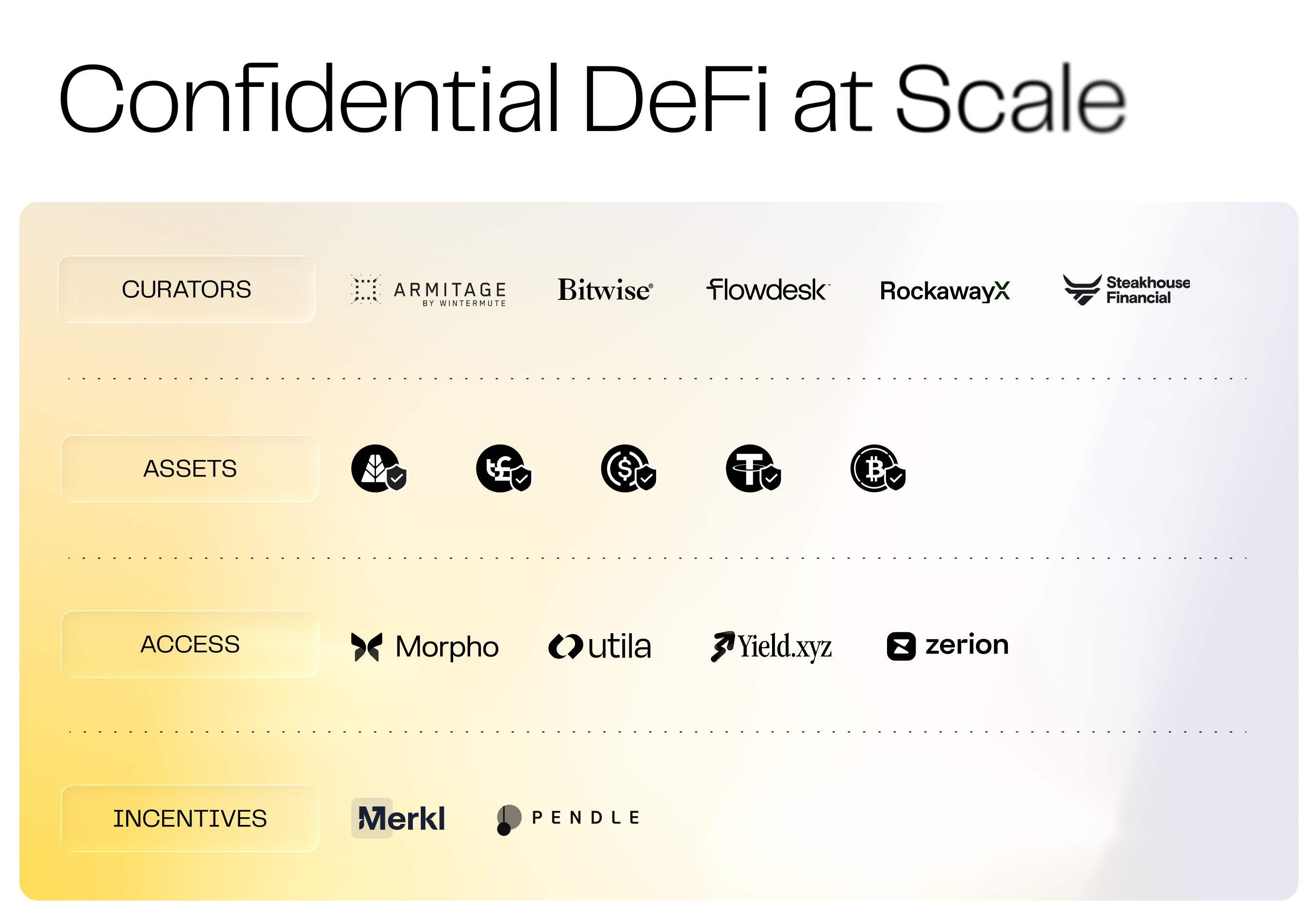
Today, we’re launching 15 new vaults across five different assets: confidential USDC, USDT, AUSD, tGBP, and WBTC. You can now actually encrypt your Bitcoin. This is not a meme. You can encrypt your Bitcoin and earn yield on it. We also now have five partners curating these strategies. We have Steakhouse, of course, which is still working very closely with us, as well as Flowdesk, Rockaway, Bitwise, and Armitage. Some of these vaults are exclusive to Zama. You can only access them by depositing confidential assets.
The Rollup: You previously had relatively narrow but deep liquidity in a few vaults, and now you’re expanding the breadth. How do you think about the balance between fragmentation and composability across the vault ecosystem?
Rand Hindi: I don’t think having multiple vaults creates much of a fragmentation issue. What becomes difficult is enabling people to swap between assets so they can move from one vault to another. That’s the second thing we launched today: our confidential swap protocol, with Flowdesk as the first market maker quoting on it. This means you can take confidential USDC, swap it for WBTC confidentially, and deposit that BTC into a vault.
You can now move laterally between vaults without ever having to unshield and disclose how much you’re moving between strategies. Think about that for a second. This is huge. It means you can not only deposit confidentially, but manage an entire portfolio of positions confidentially.
The Rollup: When this first launched around June, it was still somewhat experimental. But you saw significant adoption and some signs of product-market fit. You’ve now started referring to Confidential DeFi as a category. What gave you the conviction that the market wants this and that there is real demand?
Rand Hindi: It’s very simple. We spoke to multiple curators, institutions, and investors, and everybody says the same thing: If you want to bring trillions onchain, you need confidentiality.
Crypto adoption by institutions has been hindered in part because of regulation, but also because of the lack of confidentiality. If you’re moving $100 onchain, you don’t have much impact on the market price. If you’re moving $10 million, $100 million, or a billion dollars onchain, the market is moving. And it’s not just moving, it’s actively front-running you.
The more money someone has to manage, the more privacy becomes essential. Not just because they’re trying to hide their balance, but because they’re trying to get better execution on their trades. This is exactly the problem we’re solving.
You realize that vaults are going to be massive. Institutional RFQ and OTC onchain are going to be massive. Our vision is that it’s not going to be 15 or 16 vaults in the future. It’s going to be millions of vaults and tens of thousands of assets, including tokenized equities and tokenized RWAs.
We want to enable you to shield, hold, swap, and earn yield on all of them without having to leave the chain you’re on.
The Rollup: As vault products expand, they can move from relatively passive products toward more actively managed strategies, where assets are traded and moved between positions. That movement sends much more information to the market. Is that the right way to think about why privacy becomes increasingly important for vaults?
Rand Hindi: Yes. If you look at vaults, there are really two groups involved. You have curators, who define the strategies and curate the vaults, and you have LPs, who deposit into the vaults to earn yield.
Today, vaults are primarily collateralized lending vaults or RWA vaults. But I think this is about to change. We’re going to see more and more programmatic strategy vaults. For example, you could have an AI agent automatically manage a vault of equity positions, trading and offering exposure to a basket of tokenized stocks. You can do that programmatically. It doesn’t have to be a human actively managing the portfolio. It can be a rule-based system or a bot.
But if the rules inside your vault are public, why would someone pay you a performance fee? They can just copy the vault themselves. Privacy is therefore not just for investors depositing into vaults to earn yield. It’s also for curators who want to offer a competitive strategy without revealing the secret sauce, while still doing it onchain in a programmatic, fully automated, and verifiable way.
That’s what we enable.
The Rollup: We often say that a dollar that moves onchain tends to stay onchain. Similarly, a dollar that becomes confidential onchain may tend to stay confidential. As the amount of confidential assets onchain increases, how do you think about the network effects?
Rand Hindi: There is a massive network effect in privacy, just like there is in most DeFi protocols. The more liquidity you have shielded in your protocol, the more privacy people have because there are more actors involved and more people participating in the ecosystem. There is such a thing as a liquidity network effect. Whoever is fastest at building deep liquidity into confidential protocols, meaning multiple vaults where you can earn yield as well as deep liquidity for confidential swaps, can offer competitive execution versus public DEXs. Whoever can build that first and scale it is going to win.
It’s going to be a winner-takes-all market.
You have to think about this as two converging trends. First, do you believe finance is moving onchain? If we agree that trillions are moving onchain, and that protocols have network effects around liquidity, it means a few players are going to capture most of the activity as finance moves onchain. For me, that’s the goal. There is no point building a crypto company and doing all of the things we’re doing if it’s only going to be small sizes.
You have to go big or go home.
The Rollup: As tokenized asset classes come onchain, which area do you think is particularly ripe for disruption as privacy technology converges with tokenization?
Rand Hindi: You could almost consider vaults an asset class themselves. Here’s my thesis for vaults.
When you go to a bank today, whether I’m doing this for Zama’s treasury or for myself, you might tell your banker: “I’d like to earn some yield on my dollars or on the other assets I’m holding.” They might come back and say, “Our bank has designed this product where you can earn 7% with a long-short equity strategy.” Think about the amount of effort and time it took that bank to come up with maybe a few dozen products it can offer its customers. Onchain, that becomes a few lines of code in a smart contract. And it goes beyond that. These things are composable.
If you have a strategy at Bank A, you cannot compose it with a strategy at Bank B in the traditional financial world. They are separate products. But onchain, if those two things are vaults, they are programmable and composable. Anybody can deploy a strategy and build on top of other people’s strategies to create meta-strategies.
Think about the number of possibilities we are going to have for yield once this starts to happen. I think we will have millions of vaults. Those vaults will use RWAs, equities, crypto, stablecoins, and other assets to provide different kinds of exposure. But the thing we should be excited about is the vaults.
The Rollup: If these strategies can increasingly be expressed as smart contracts, why don’t banks, ETF providers, and other traditional financial institutions simply build their own vault stack? What edge has Zama established with confidential vaults, Morpho, and its other partners?
Rand Hindi: There are a couple of things.
There are many privacy technologies, and every other day I see someone tweeting that they’ve launched something better than Zama. I want to be clear about something: if someone does launch something better than what we’re doing, we’re going to take inspiration from it and do it. I’m very pragmatic. I just want the best technology to solve a particular problem: how do you make finance go onchain at scale? Today, I believe that technology is FHE. If someone invents something better tomorrow, I’ll use that.
With that in mind, the technology itself doesn’t matter as much as the products and framework you build around it. You need deep integrations. You want wallets to support it. You want custodians to support it. You want DeFi protocols to support it. Zama today is very widely integrated. For example, we just announced that Utila is integrating Zama, so anybody using the Utila wallet framework can use confidential assets. Zerion is also integrating. I don’t want to give too much detail, but there are other major players currently integrating us. Integration is number one: making confidentiality accessible everywhere through the same tools people are already using today.
The second thing is programmability. FHE is unique in the sense that you can program whatever you want on top of encrypted state onchain. You can have composability in Confidential DeFi in the same way you have composability in regular DeFi. This is a unique advantage of FHE and Zama.
And finally, compliance. Because of this programmability, we can also program compliance rules and disclosure rules into smart contracts.
We can tick the boxes required to build compliant, programmable finance onchain. When you put all of these things together, you realize that there are not many technologies that can do all of that in the way we can today.
The Rollup: Zama started from an FHE research primitive and has progressively built financial applications on top of it. How did that evolution happen?
Rand Hindi: It was an iterative process. Today, my thesis is that vaults are going to be massive, and that institutional OTC onchain is going to be massive. But we didn’t start like that.
When we started Zama a few years ago, our thinking was: “We want to make FHE work because we think this technology is important. As we do that, we’re going to talk to a thousand companies and see who actually wants to pay for it.” We looked at confidential AI, confidential databases, confidential medical research, and confidential blockchains. We found that blockchain was where there was a real opportunity because on a blockchain, everything operates on a public network.
When we realized that Zama could build HTTPS for Ethereum and Solana, allowing people to transact on those public global networks privately, just like you can buy something on Amazon privately today or prompt ChatGPT privately over the internet, we realized we might be solving a real problem. That was step one: becoming a blockchain company building HTTPS for blockchains.
Then we looked at the business model.
We could charge gas fees for confidential computation, but gas fees are going to zero. The cost of infrastructure is going to zero. Unless you have a billion transactions a day that people are paying tiny amounts for, you’re not going to make a lot of money, especially if you’re targeting institutions that don’t necessarily trade frequently but trade very large amounts. Gas fees are a lousy business model. We realized we needed to build value where the value actually is and find a way to monetize the value we provide to the end customer.
That is finance: confidential swaps, confidential vaults, and confidential payments.
Today, even though we still have around 40 PhDs and remain a very R&D-heavy company, I think we can primarily say that we are an onchain finance protocol that uses FHE to solve a problem institutions have today: privacy onchain.
The Rollup: Zama has a public token. If gas fees are not the right monetization strategy, what do you think is the right model for an onchain finance protocol? And how do you think about value accrual for the ZAMA token?
Rand Hindi: When you look at finance or fintech in Web2, there aren’t a million ways to make scalable revenue. Subscriptions are one. You can charge people a monthly fee for doing something. Another is taking a cut on a flow of money, whether it’s a payment, a swap, or an escrow. Effectively, it’s a percentage-based business model.
But to do that, you need to bring more value to the end customer than whatever they’re paying you in fees. In our case, it’s very simple. If you’re swapping confidentially onchain, there is no MEV and no front-running. You can get a better execution price by swapping confidentially, even including protocol fees, than by swapping publicly on a DEX and suffering from MEV and slippage. Those are the kinds of models that can build scalable revenue.
I also think product-market fit is not something you just measure. It’s something you know when it’s happening. You see people using your protocol even though it’s not perfect, even though it has missing features, even though it’s still early. People are genuinely excited about using it. Then you know you’re onto something.
The question becomes: how can I take this early adopter feedback and turn it into a $100 billion protocol?
For us, it’s very simple. 100% of the fees collected by the Zama Protocol, from payment fees and swap fees to curator revenue share and stablecoin yield kickbacks, will go toward two things.
The first is funding adoption of the protocol. For example, that could mean funding incentives to attract TVL into vaults that eventually generate swap fees.
The second is buyback and burn of ZAMA tokens.
Right now, my thinking is that we should spend aggressively on TVL acquisition. There is a network effect around liquidity in a protocol. If we can bring TVL to Zama faster than competitors can bring it to their own confidentiality protocols, then we have a real moat. Then we can start thinking about buybacks and burns at scale. There is no point spending $10 million on buybacks and burns today if you could spend that $10 million creating $100 million of buybacks and burns a few years later. We shouldn’t think about what we’re burning tomorrow. We should think about what we can burn over a four-year period. That’s the game.
The Rollup: What convinced curators to put their names behind confidential yield? And how do you see the relationship between Zama and these curators evolving?
Rand Hindi: There are a couple of things.
First, these curators are highly innovative. They want to try new things, and this is something new. Second, their LPs are demanding privacy. They had actual demand from their own customers for privacy.
What really changed the narrative was when we launched the first vault with Steakhouse and Morpho. And by the way, thank you to Steakhouse for trusting us and being the first. When that first vault became one of the top 10 USDC vaults on Morpho, people started paying more attention. They started thinking: maybe this is not just marketing. Maybe there really is demand for privacy in vaults.
We’re going to continue building this snowball effect. The goal is to grow TVL exponentially. Eventually, we want every financial transaction onchain, every payment, every vault deposit, and every swap, to be encrypted using Zama.
The Rollup: Anything you’d like people to try following today’s launch?
Rand Hindi: I’d encourage everyone to try depositing and swapping. See how familiar the experience is, and yet how different it looks onchain.
The 16 confidential vaults and the Zama Confidential Swap Protocol are live today.
Confidential DeFi is now a category.
News, research and product releases
Protocol

Solutions
PRODUCTS
Resources
community
company

.svg)
.svg)