Zerion is now one of the first wallets to support confidential tokens on Ethereum mainnet. The wallet and developer API cover 58 chains and around 10 million wallets, nearly half of them monthly active.
In this conversation, Kyle O'Brien, VP of Capital Markets and Investor Relations at Zama, sits down with Alex Bashlykov, CTO and co-founder of Zerion, and Zama CEO Rand Hindi to discuss how confidentiality changes wallet design, why the wallet is the key to distribution, how the confidential swap works, and why yield is what brings users to privacy.
Watch the full conversation, or read the transcript below.
Edited transcript
Kyle O'Brien: Public blockchains have always been exactly that: public. How does the design space change when you introduce confidentiality into wallet UX?
Alex Bashlykov: People have always had to adapt to everything being public, and the way they adapted is by having different wallets, including the ones they are trying not to disclose to anyone. Everyone has too many wallets, which creates a whole new set of UX problems just because privacy is not there. If you have a Coinbase account, you do not bother having 20 accounts. In crypto, people are forced to, and then they lose private keys or forget them. So it is very exciting that we are finally entering the stage where blockchains can become more private. In the long run it simplifies a lot: users will be comfortable having a single account, without the mess, and without being afraid to reveal their assets or transactions to the public.
This integration itself was fairly straightforward, so kudos to the engineering team on the Zama end. The interesting bit is that confidential tokens hide the amounts, not the recipients, and it was fun to build features where a user signs a message in the interface, reveals their balances, and has the comfort that they are the only one who can see how much money they have in a position. That is pretty novel for this space.
Kyle O'Brien: Rand, why did Zama decide not to hide the sender and recipient?
Rand Hindi: We could do it; we could launch it tomorrow. There are two reasons. First, compliance: if you are trying to be anonymous, you will hit regulatory hurdles, especially for institutional and regulated use cases like payments and neobanks. Compliance is simply easier when the sender and recipient are visible. Second, think about HTTPS, which we use every day for everything from encrypting your prompts to buying things online. It does not hide the domain. The recipient you are connecting to is public. There is a version of HTTPS with anonymity, which is Tor, and it is extremely difficult to run a business on top of it from a regulatory perspective, and most people do not care. We are trying to be HTTPS for onchain finance, and we stand by that.
Kyle O'Brien: A key component of adoption at scale is embedding confidential tokens in existing infrastructure: wallets, custody, exchanges. What do wallets unlock as a distribution vector?
Rand Hindi: It is the key piece of the puzzle. There are two major actors: custodians, because institutions do not want to manage wallets themselves, and wallets, used by everyone from retail to people like me moving reasonable size. If you want confidentiality to be ubiquitous, if you really want Zama to be HTTPS for onchain finance, you have to be where the user actually is. Fundamentally, we are a middle layer of encryption between the user and what they want to do onchain. If we do our job right and integrate seamlessly, the user does not even know it is encrypted. Maybe there is a small lock in your browser: you know it is there, it makes you feel safe, but you do not think about it. I like to say that if Zama is successful, you do not have to think about Zama. You just use Zerion.
Kyle O'Brien: Five years from now, will people log into Zerion and use confidential tokens without thinking twice?
Alex Bashlykov: Very likely. The most interesting bit is how we get from the status quo, where everything is open by default, into the encrypted world. Once everything is encrypted by default, the user does not need to think about it; the HTTPS analogy is great. The transition is the tricky part. Even if you encrypt existing tokens, there is still a way to backtrace what a wallet held in the first place. I can see the future where everything is encrypted and works smoothly. The transition is where it is going to be hard.
Rand Hindi: We think about that every day, and we address it in two ways. First, we co-design the user experience with teams like Zerion inside real applications. We are not dogmatic: if a different design pattern works better, we implement it. Second, and harder, in privacy you have to bootstrap two things. You bootstrap the privacy sets: the more people use the protocol and stay in it, the more privacy everybody gets. One confidential vault does not give you a huge amount of privacy; with 16 vaults, it is exponentially harder to figure out what is going on, and it improves with every one we add. And you bootstrap liquidity. Privacy is going to be winner-takes-all: funds shielded in Zama cannot be sent to someone using a different privacy technology. So the more liquidity comes in, the more market makers quote for confidential swaps and the more curators launch confidential vaults, the better it becomes for everyone. That is why we work so closely with the curators and market makers who believe this should exist.
Kyle O'Brien: We need to onboard people and retain them. How does yield work as a retention mechanism?
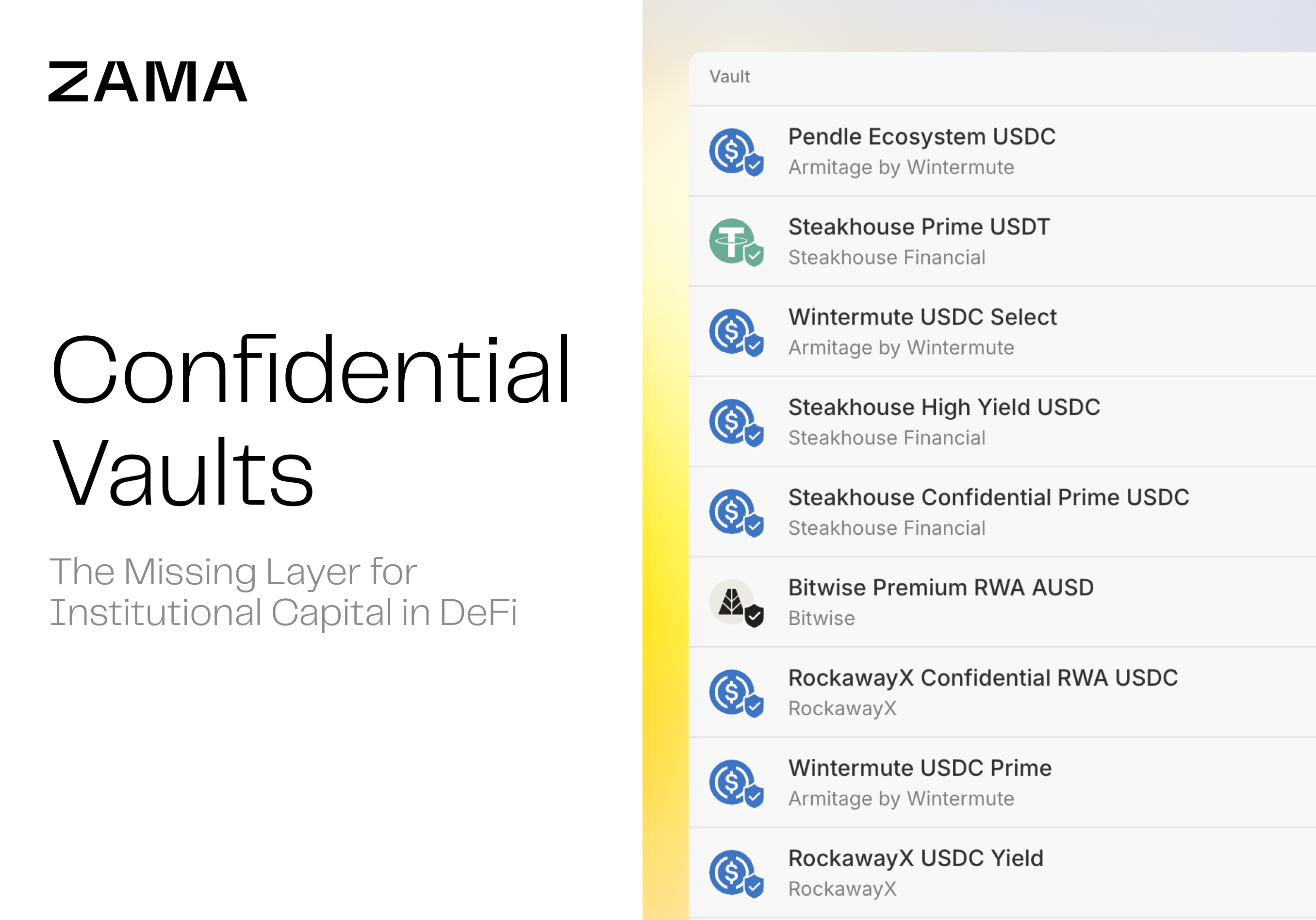
Rand Hindi: You cannot just airdrop tokens and hope people stick around. I prefer vault incentives, because they add to something people already want to do: put funds into a vault with a strategy they want exposure to. We see it today: some of the 16 vaults have much higher yields, and they are not the ones people deposit into the most. It is about the quality of the curator and the strategy, not just the number. Our entire strategy is that people do not care about privacy. But if they have it and realize it costs them nothing, they notice they get better execution because there is no MEV, and better yields because there are more strategies. Most people do not care about the vision. They care about the immediate effect on what they do onchain, which is earning, investing, and trading. We just want to make that better. Come for the incentives, stay for the privacy.
Kyle O'Brien: Do you have a sense of your typical user: what they do, what assets they chase?
Alex Bashlykov: Ten million wallets does not mean ten million users, since many users have many wallets. But the number one use case is send. Whatever else people do, at some point they move their money. That is why privacy is especially exciting in the context of send: when you pay a friend or a business, you do not want to reveal all the assets you have. After that, swaps native to the wallet and general contract execution, people using dapps of every kind, are each somewhere between 50 and 60% of users. NFTs are the long tail; maybe 20 to 25% still mint occasionally.
The largest cohorts are simple: stablecoins and large caps, with the biggest trades between them. There are distinct, seasonal cohorts of meme coin traders; after the Robinhood Chain launch we saw a lot of that. The interesting finding from our Robinhood onchain analysis is that the cohorts overlap: the person buying tokenized Nvidia and the person buying a meme coin that dies in three hours are often the same person.
Kyle O'Brien: Vaults are taking off. Does it make sense for Zerion to curate vaults, or is this a plug-in partnership?
Alex Bashlykov: Right now it makes far more sense to plug in other players. We are the interface the end user interacts with: we want to control the experience and help people find the right vault for their risk criteria and appetite, not be the issuer or curator. That is a very different game. We have always been huge on interfaces. When we raised our seed round in 2019, the fat protocol thesis said protocols matter and nobody cares about interfaces. We were running around saying we want to build the interface because it matters more. Over time it is becoming evident we might have been right.
Rand Hindi: You do not have to curate. You own the distribution, and crypto is discovering that distribution is the only thing that matters eventually. If everybody has a working product, how do you get it into the hands of a billion people? I am super bullish on the interface layer. The fat protocol thesis is like saying a telecom operator should own the social network on top of it. They are fundamentally different jobs. Zama has an important role to play, but we are not the wallet. We depend on wallets for people to use our protocol.
Kyle O'Brien: Walk us through the mechanics of the confidential swap. It is not Uniswap, and it is not an OTC desk.
Rand Hindi: Look at the spectrum. Order-book trading is about latency and depth of book, very difficult fully onchain; Hyperliquid cracked it for perps, a category in itself. AMMs, swapping against a bonding curve, are almost impossible to do confidentially, whatever the technology: either the trader has latency and the market moves against them, or the LPs need latency to rebalance and the market trades against them. Someone has to take risk or someone has to see what is going on. OTC is one of the biggest markets to go after, and we are building an OTC product. And then RFQ: market makers hold their own liquidity, and instead of a bonding curve they set the price. You send a request, they fill it at that price, and it settles atomically. The key difference is that there is no LP in the loop, so nothing trades against anyone. That is why we chose RFQ.
V1 is working; it did a few million dollars of volume in a couple of weeks. We already see that the fill you get on the Zama RFQ versus any other DEX is better, so the execution is better. Best price wins: it is an auction, and in V2 users will choose which market makers they want quotes from. If we fix the UX quirks of V1, we have a shot at becoming the biggest RFQ trading venue on blockchains.
Alex Bashlykov: RFQ with onchain settlement is a really great primitive. There is still no trust anywhere: it is fully settled onchain, you get the market maker's signature and the user's signature, and it just works. I think it is actually the way to do it, and we will definitely integrate it.
Kyle O'Brien: Tokenization is ramping up: RWAs, tokenized stocks. Is it an accelerant for onchain activity and for privacy?
Rand Hindi: In the next couple of years we get tens of thousands of tokenized assets: stocks, commodities, energy, real estate, art. Once you have them, you can hold them, but you can also swap them. Trade your tokenized Nvidia for a share of a building in Paris. In the real world that is weeks of notaries, brokers, and banks asking a million questions. Now it is one transaction in your Zerion wallet, under 12 seconds on Ethereum, sub-second on other chains. And then vaults: package those assets into strategies, and if you just want to make more dollars with your dollars, you will have a million ways to do it. People will not just build lending vaults; they will build agentic hedge funds. A data scientist on the other side of the planet with a great portfolio strategy will put it onchain confidentially. There are going to be trillions of volume around this.
Alex Bashlykov: Liquidity in tokenized stocks is clearly growing. Where liquidity goes, institutional traders and hedge funds follow; their business is simple. And privacy is probably the biggest blocker stopping them from trading onchain, because they do not want to reveal too much. I do not see privacy as a big blocker for retail on the DeFi side, but it is a deal-breaker for hedge funds and institutions. A parallel thing is payments. Both are inevitable, but they are not the same: on the yield and DeFi side it is about institutional money, while payments is where privacy matters for anyone and everyone.
Kyle O'Brien: To close: your bull thesis for privacy. What gets you excited about scaling the confidential token ecosystem?
Alex Bashlykov: On a personal level, privacy by default: not having to think, every time I move money between my wallets, about who knows this address and how not to overexpose. Every prosumer in crypto has that problem. On the bigger picture, payments is my biggest bet. There are so many attempts to move payments onchain, and someone is going to win, and none of it is going to work without privacy.
Rand Hindi: My thesis is very simple. 95% of financial transactions on public blockchains are going to end up encrypted with Zama, the same way 95% of internet content is encrypted with HTTPS. It is winner-takes-all. There are only two paths for Zama: either we win and it is huge, or someone else wins and they are the privacy layer. Fortunately, we are starting very strong, and I am very confident we can be the HTTPS for public blockchains.
Confidential tokens are live in Zerion.
Come for the yield. Stay for the privacy.
News, research and product releases
Protocol

Solutions
PRODUCTS
Resources
community
company