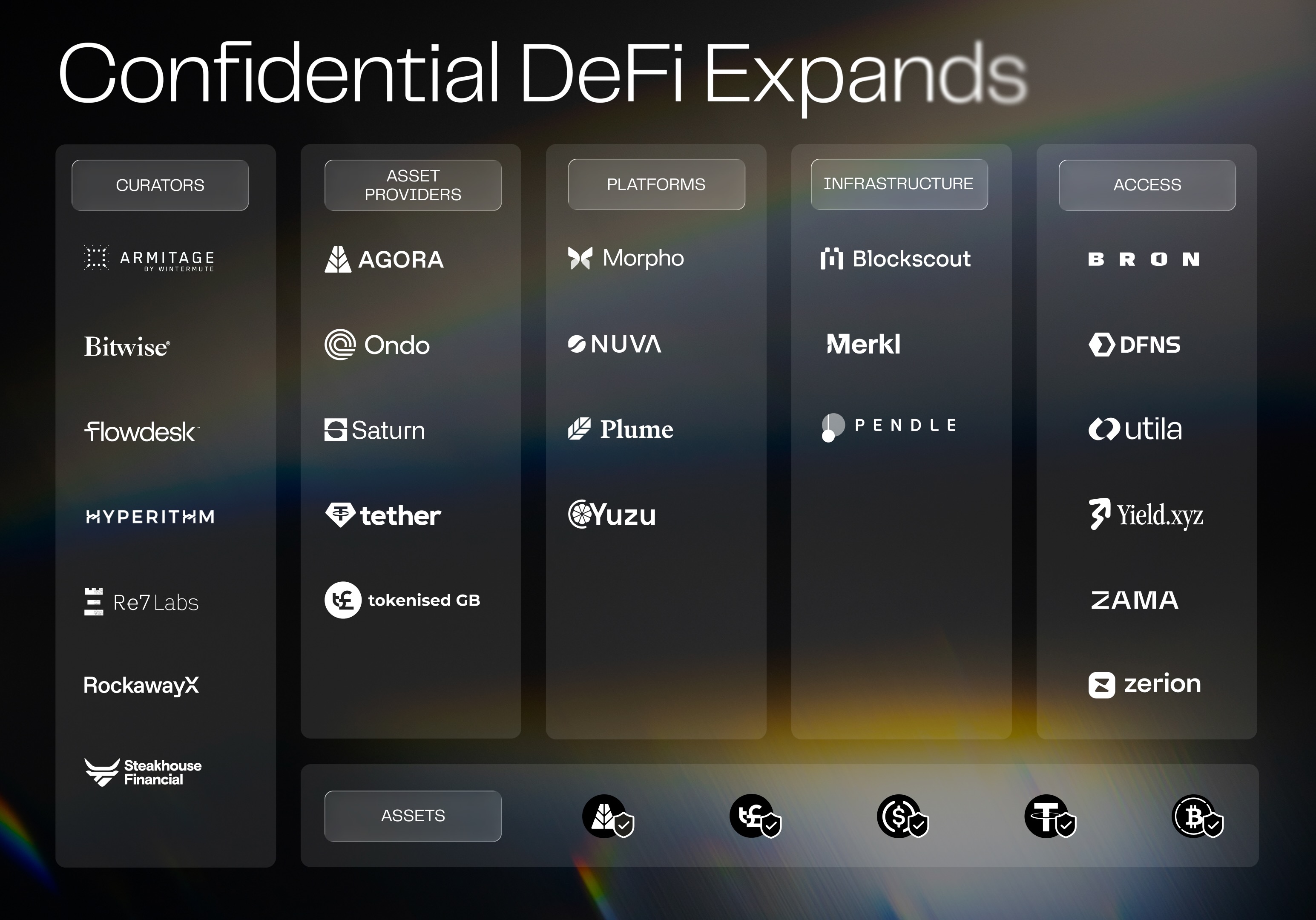
The Wintermute Confidential WBTC vault powered by the Zama Protocol is now live on Morpho.
WBTC is a token backed 1:1 by Bitcoin, with around $9.7 billion in market cap (source: WBTC proof of reserves, as of October 14, 2026). It has been bringing Bitcoin into DeFi since 2019.
In this conversation, Kyle O’Brien, VP of Capital Markets at Zama, sits down with Nadia Song, Director of Marketing at BiT Global, and Zama CEO Rand Hindi to discuss the history of WBTC, how confidential deposits reach a Morpho vault, why the Zama Protocol encrypts amounts and not addresses, what quantum computing means for encrypted assets, and why nobody buys privacy but everybody needs it.
Watch the full conversation, or read the transcript below.
Edited transcript
Kyle O’Brien: Famously, Bitcoin has not been usable in DeFi. One of the big problems WBTC set out to solve was enabling DeFi access and DeFi strategies for Bitcoin. Can you give us a bit of the history?
Nadia Song: I have been in crypto for eight years, and DeFi has always been the area I am most interested in. When I went for the interview at WBTC I was so excited, because Bitcoin is my god. I was not with the founding team, but here is the history. In 2019, when people started using DeFi, you realized that Bitcoin cannot be used in DeFi. We cannot find Satoshi anymore and we cannot edit the code. So WBTC came up, to bring Bitcoin into DeFi. For a long while it was only on Ethereum, but over the years we have expanded to 21 chains. I think it is one of the biggest achievements in DeFi. Our market cap moves with the Bitcoin price; at $83,000 it is about $9.7 billion, 116,332 BTC of total supply, and only about 50% of it is in DeFi. Our main objective is to make sure WBTC remains easy to use, liquid, and well integrated across the DeFi ecosystem.
Kyle O’Brien: When I think of Bitcoin, I think of one of the more institutional blue-chip tokens: ETFs, insurance products, every large traditional institution holding a basket of tokens holds Bitcoin. Is WBTC institutional in the same way, or is it a different makeup of holders?
Nadia Song: We have more institutional than retail users, and there is a reason. We did some research and realized that a lot of Bitcoin holders do not know they could do more with their Bitcoin. Newcomers buy Bitcoin as one of their first products, and then they just keep it. The moment they buy, they ask what it means, and they do not understand the jargon. So we need to keep things simple and easy to understand to attract new users.
Kyle O’Brien: Four of the five assets in the Zama app are stablecoins; one is WBTC. The primary customer we serve through confidential DeFi today is the institutional DeFi player: asset managers with an existing onchain portfolio who understand how to generate yield and run a portfolio onchain. How does an encrypted version of WBTC in the Zama registry help build that base?
Rand Hindi: Very few investors want to stick to one asset. They want to manage a portfolio so they can adjust their risk and return: Bitcoin, but also different yield strategies, other RWAs, tokenized stocks. We want to support whatever assets investors want to hold. And we want to enable people to swap confidentially. If you hold confidential USDT and want to rotate into confidential WBTC, having to unshield, swap, and shield again misses the point. That is why we rolled out the confidential RFQ, and soon a confidential OTC product, so you can rebalance your portfolio without ever unshielding and exposing your strategy and positions.
Kyle O’Brien: Armitage is the curator running the WBTC vault. At what point do I shield my WBTC? How do I deposit? What is hidden, and what is not?
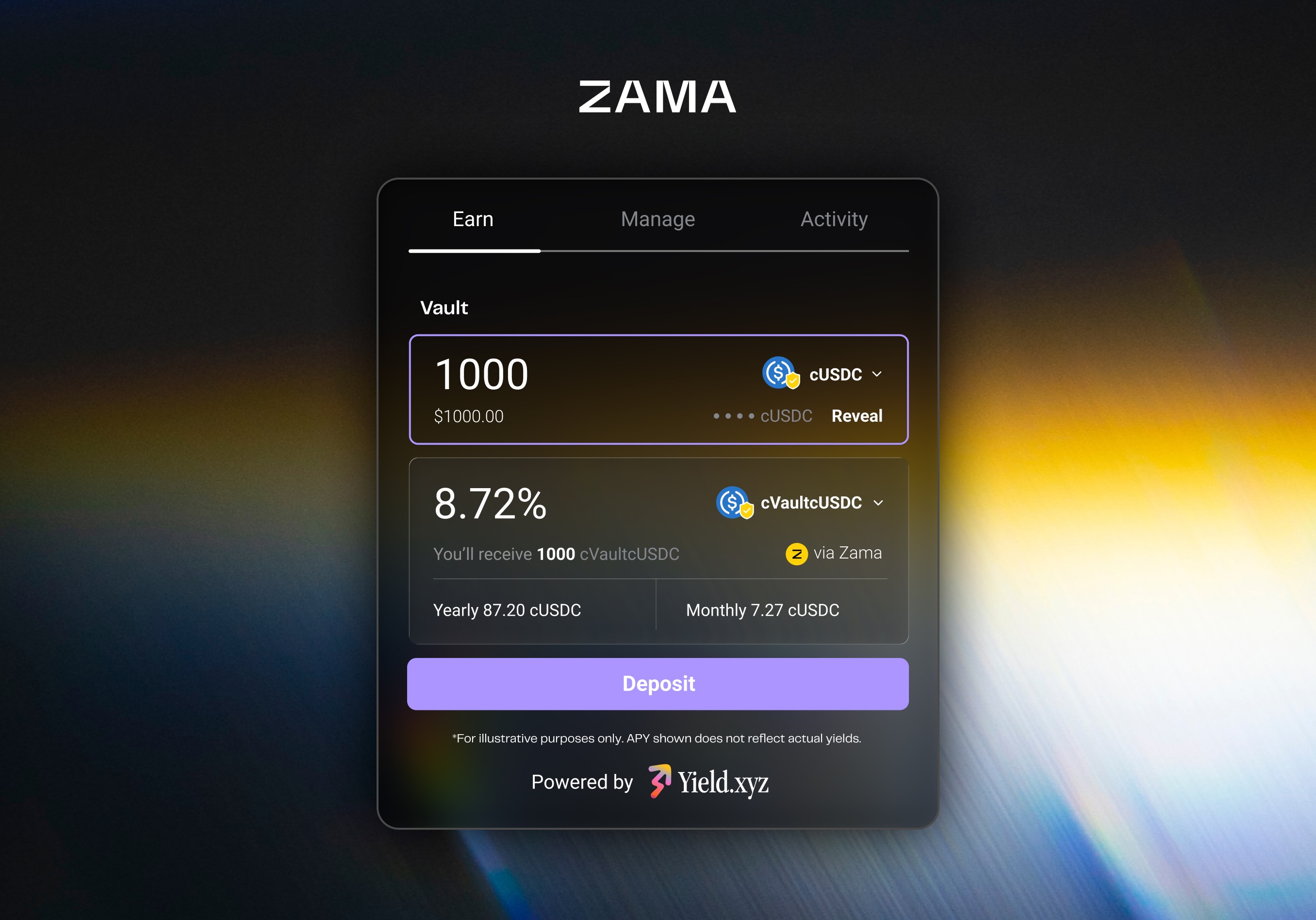
Rand Hindi: The WBTC vault by Armitage is a Morpho vault. You have WBTC on Ethereum, you shield it without moving to a different chain, it becomes confidential WBTC on Ethereum, and you deposit it into the vault. That is it. From the user’s perspective, their WBTC is shielded, they put it in a vault, they earn yield on it, done.
Nadia Song: Every time a new vault comes about we give our utmost support, because we hope it will be the one that increases adoption. We have always been looking for products that are more out of the box, not the everyday thing everybody is doing. What Zama has is really interesting, and that is why we are here: it is privacy. Everyone has a vault. But this one is shielded.
Nadia Song: The best way to bring down risk is never to expose your address. Does a privacy vault mean the addresses are not exposed, so it also brings down the quantum risk?
Rand Hindi: By default, the Zama Protocol does not hide addresses. It is not like ZK, where you have anonymity. Zama gives you encrypted balances, encrypted amounts, encrypted trades: we hide the content. A good comparison is Signal. I can send you an encrypted message over the public internet, and people can see I sent you a message, but not what it says. That is what Zama does. Hiding sender and recipient is more like Tor, which anonymizes your IP so nobody knows who connected to which website. From our experience, if you want to build institutional products, you need compliance built into the protocol, and compliance is extremely hard if you cannot know who has been interacting with whom. So it was a trade-off.
On quantum: fully homomorphic encryption is already quantum resistant. The data you encrypt and put onchain today, as far as we know, cannot be broken by a quantum computer. If you could break Zama’s encryption, you could break most of what has been standardized for post-quantum communications, and the world would have far bigger problems than people knowing how much money you have onchain. What is still missing is that the blockchains themselves, Ethereum, Bitcoin, are not quantum resistant. Until they move to post-quantum signatures, the weak point will not be FHE and Zama but the signatures people use today. People are working on that, and I am confident it will be fixed.
Nadia Song: What we look for in the people we work with is a real understanding of our audience: security, risk, and what institutional customers want. That is one of the most important things for us.
Rand Hindi: There is what I believe philosophically: end-to-end encryption, privacy everywhere, nobody should know what you are doing. And there is the reality of running a business, where you have to look at the biggest market you can tap into. The addressable market for institutional, compliant finance is much bigger than dark finance. I would much rather Zama be extremely successful in existing financial systems than in a tiny market that institutions will never adopt. That means compliance, and it means security. I have told my team we have only two jobs. One is to make money, which is the point of a business. The more important one is to never lose customers’ funds. That is the number one priority, and it is a moving target with AI and quantum. You have to constantly update your threat model. I do not think we have ever been in a situation where cybersecurity was this crazy.
Kyle O’Brien: The second arm of our go-to-market is ease of use: making confidential DeFi as frictionless as regular DeFi, and integrating the confidential token standard into the infrastructure where capital already sits, wallets, custodians, exchanges. How are you thinking about that, and what will move the needle in the next three to twelve months?
Rand Hindi: A good technology is a technology that disappears into the background. If we want Zama to be successful, Zama needs to be woven into whatever products people are already using. Nobody is buying privacy. Privacy is not something you sell. Privacy is an enabler for use cases that would otherwise not be possible on public blockchains. How do you trade efficiently if the entire world is looking at your wallets, if every time you start to trade onchain you have 100,000 hedge funds trading against you? You cannot. We have estimated that for less liquid tokens you can lose up to 30% of your upside to market signaling and front-running. People keep saying blockchains without confidentiality work fine. It reminds me of the picture of the airplane with the bullet holes. People think nobody cares, because the only people onchain are the people who do not care. The majority of people who are not onchain care a lot. If you pay for something from your bank account, you do not want your neighbor to know. If you are a fund that spent years building a strategy, you do not want competitors to copy it or front-run you. That is what we are unlocking. We believe this is the HTTPS moment for onchain finance.
Nadia Song: Privacy does not come up regularly with our institutional clients yet, but conversations are starting, exploring privacy chains and privacy protocols. For institutions it is really interesting. They do not mind you knowing that they are connecting to something. They do not want you to know in detail what is going on. A privacy protocol protects that part.
Kyle O’Brien: Where is most WBTC held, and does the traditional Bitcoin community overlap with the WBTC community?
Nadia Song: In terms of chains, 90% of WBTC is still on Ethereum, with Arbitrum maybe second. In terms of credibility, Ethereum still works best. The biggest use is lending and borrowing on Aave. As for the Bitcoin maxis, they are different people, and they would not want to listen to us. What I am looking forward to is a product that can really convince the Bitcoin maxis to come into DeFi. Why so lonely?
Rand Hindi: I am not surprised 90% is on Ethereum. The Bitcoin community is the most security-oriented in crypto, and if you are going to add a layer of counterparty risk, you might as well use a chain that is battle-tested, with deep liquidity. The rest is cultural: we spent 15 years telling people to hold their Bitcoin and do nothing. It is a big narrative shift if Bitcoin becomes widely used in finance.
Kyle O’Brien: To close, what is in store for the next six to twelve months? Nadia, from the point of view of WBTC and BiT Global; Rand, on confidential DeFi.
Nadia Song: DeFi might change its shape. We used to be young and rebellious, we wanted decentralization and transparency, and then we had our karma. DeFi will change shape to welcome more users and to protect them. Privacy is inevitable and will become a cornerstone of the future financial system. As for WBTC, we are normally low profile, normally confidential, but we have exciting things coming, and working with Zama is one of them.
Rand Hindi: DeFi is turning into onchain finance: more structured, more amenable to institutions, with compliance playing a big role and RWAs being tokenized. That is a much bigger market. There are $500 trillion of financial assets waiting to come onchain. In a few years we will talk about trillions where we talk about billions in DeFi today. So I am very bullish for 2027. For Zama, the goal is simple: be integrated in as many places as possible, every wallet, every custody solution, every vault, every swap, so people get confidentiality in everything they do onchain without thinking about it, the way you connect to a website with HTTPS. And build deep liquidity for shielded assets: we want to get to a point where you can swap $100 million shielded and get the same execution you would get at an OTC desk today. We are going to get there.
Depositing in a vault carries risk, including smart-contract risk, the curator’s lending decisions, and the custody and freeze risk of WBTC itself. This post explains how the technology works and does not recommend any vault.
News, research and product releases
Protocol

Solutions
PRODUCTS
Resources
community
company