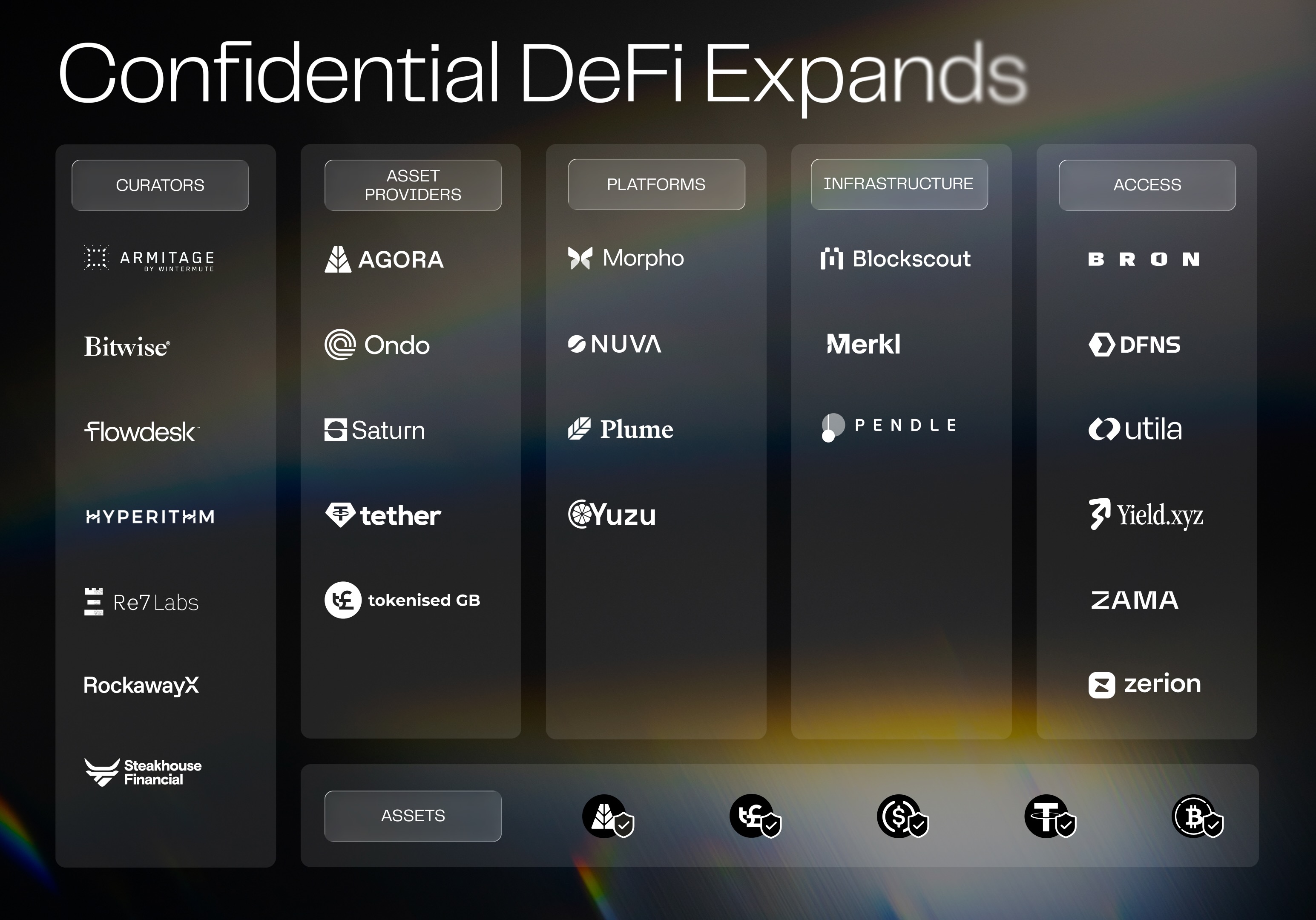
Yield.xyz aggregates thousands of yield opportunities, across 80-plus networks, and serves them through one API to wallets like Ledger, Trust Wallet and Utila. Until now, every one of those positions was public.
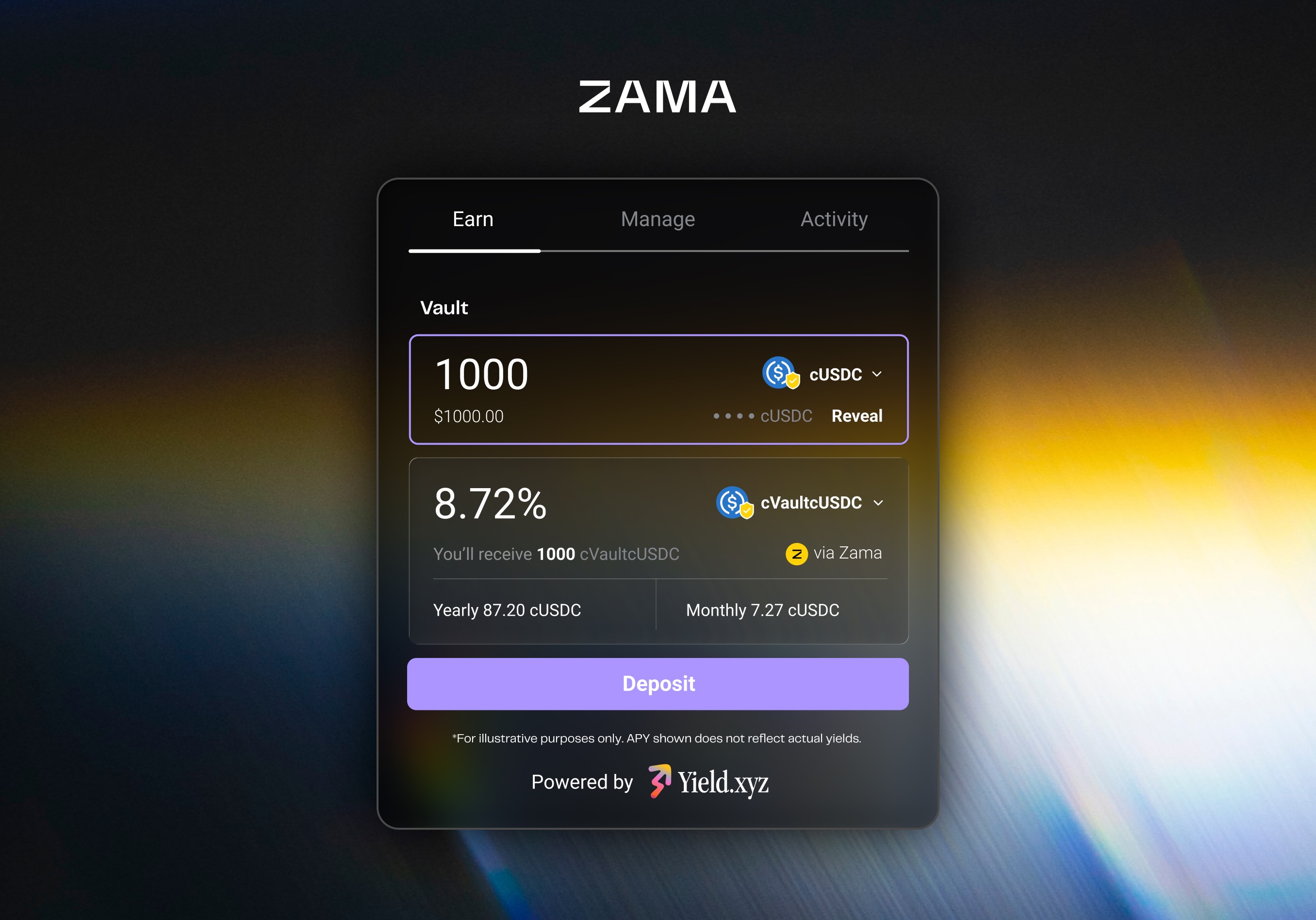
Zama's confidential vaults are now part of that yield surface. Through Yield.xyz, the wallets, neobanks and custodians already plugged into its API can offer the same strategies, entered completely confidentially.
In this conversation, Kyle O'Brien, VP of Capital Markets at Zama, sits down with Sebastian Faria, Head of Institutional at Yield.xyz, and Zama CEO Rand Hindi to discuss why distribution is the hardest problem in onchain yield, what bank risk committees actually ask about, why compliance has to be built into the protocol, and why staking, DeFi and RWAs will all collapse into vaults.
Watch the full conversation, or read the transcript below.
Edited transcript
Kyle O'Brien: Sebastian, what does Yield.xyz do, and what was the insight that got you to join?
Sebastian Faria: When I was on the staking side of the business, the hardest part of the job was getting platforms to integrate us. I would go to retail wallets and say: we are a validator, we support 25 chains, let's work together. The answer was always the same: we work with Figment and maybe P2P, why do we need a third validator? That is a very difficult question to answer. So there was a gap in the market. We needed a wholesale marketplace for yield where every validator has a fair chance to compete for the flow. This already exists in traditional finance: platforms like Tradeweb or Bloomberg aggregate liquidity and let a hedge fund route an order to whoever offers the best price. Best execution. There was nothing like that in Web3. We started by aggregating staking providers. Then we expanded to DeFi, because with stablecoins in focus we knew protocols like Aave, Morpho, Spark, Fluid and Gearbox were going to grow. And most recently RWAs, where we aggregate eight issuers. So instead of a fintech, a neobank or a custodian integrating validator by validator and protocol by protocol, six months apiece, they get the entire yield surface, plug and play, with one integration.
Kyle O'Brien: We have run into the same chicken-and-egg problem: you need both sides of the market. We have built the confidential vaults, and in parallel an SDK and an API so infrastructure providers can integrate confidential tokens, vaults and swaps. Rand, how does the partnership with Yield.xyz accelerate distribution? And Sebastian, who is on the other end of your API?
Rand Hindi: What we built at Zama is a confidentiality layer for onchain finance. Think of it like HTTPS for blockchain transactions, on Ethereum and Solana. What Yield has built is the integration of DeFi and onchain finance into the products people actually use: wallets, custody accounts, front ends. So it is very natural for us to work with them to get closer to where the users are. Right now users come through the Zama app and a few direct integrations. This is a way to get much broader distribution for confidential assets, vaults, and other opportunities in the future. Yield has done a great job working with everyone, and it makes a ton of sense for us to work with them.
Sebastian Faria: When I joined a year and a half ago we already had a strong footing in retail wallets: Ledger, Zerion, Tangem, and since then Trezor and Trust Wallet. The natural progression was institutional wallets, Fordefi, Utila, Porto by Anchorage, DFNS, Bron and others, and now neobanks. We are in conversations with the regulated custodian platforms, which take longer because regulation adds complexity, and with exchanges, the next cohort.
Kyle O'Brien: Brick by brick, wallets, custodians and distribution partners are starting to support confidential tokens. Where is the tipping point for this to become ubiquitous?
Rand Hindi: For a long time, privacy onchain meant "nobody should know it is me": anonymity. Then it became "nobody should trace my transactions, even if they know it is me": unlinkability. What is happening now, thanks to Zama, is confidentiality of your onchain data: your balances, your transaction amounts, the assets you trade, the vaults you deposit in. That opens up a whole class of applications that were not possible with anonymity or unlinkability alone. So the first tipping point is simply better technology: more composable, and a better fit for an account-based blockchain. At the same time, onchain finance is growing very fast as a category. We talked about tokenization for a decade, but it only started materializing in the last couple of years. Those pieces together create massive tailwinds for companies like Yield and Zama over the next 24 months, as core infrastructure for this onchain finance movement.
Kyle O'Brien: Sebastian, in your conversations with institutions, does privacy come up, and more often than it used to?
Sebastian Faria: Absolutely. We speak to a lot of compliance teams and risk committees at banks, very long conversations, 12 to 18 months. They are concerned with two things. One is compliance. Many have told us they do not feel comfortable deploying capital into a permissionless lending pool when they do not know who the borrowers are. There are neat solutions like Hypernative and Blockaid, which we have integrated so clients can monitor the toxicity of lending pools, and if a threshold is crossed, we can withdraw their funds. The second topic is privacy. If you are a fund, a hedge fund, any asset manager, you do not want the street knowing what you are doing onchain: worse execution, people copy-trading you. Those are the two topics that come up most on the institutional side.
Kyle O'Brien: Rand, how are you thinking about compliance, as institutions come to us as the thought leader on the intersection of privacy and compliance?
Rand Hindi: Compliance is an essential part of onchain finance. If you are serious about moving trillions onchain, you have to do it in a way that works for finance, and compliant onchain finance is orders of magnitude bigger than dark finance. So our choice is clear: we want to build the biggest protocol for confidential onchain finance, and that means building compliance into the protocol and the tools. We are not reinventing the wheel. A token issuer can give itself visibility on the transactions people make with its asset. Most people would be fine with Circle seeing confidential USDC transactions, because Circle can then comply with whatever it has to comply with. The confidentiality is with regard to random people onchain, not the issuer, the service provider or the exchange you trade with. That is how finance works today. I can see my bank account, my bank can see all of its customers' accounts, and my neighbor has no idea what I am doing or how much money I have. We are bringing that kind of compliance onchain.
Kyle O'Brien: At Token2049 this year, vaults were the centerpiece of every conversation: vaults as structured products, hedge funds run out of vaults, meta-vaults, protecting your alpha. You sit at the center of that infrastructure. What is Yield's thesis on vaults?
Sebastian Faria: A lot of what exists in traditional finance as ETFs will become a vault onchain eventually. At Yield.xyz we built our own vault infrastructure: sentinel vaults and meta vaults. Sentinel vaults use our Hypernative and Blockaid integrations to monitor toxicity and exploits; if something happens, we withdraw client funds automatically and keep them AML compliant. Meta vaults are multi-strategy vaults, the onchain version of a fund of funds. A neobank can say: I want the Revolut USDC prime strategy and Revolut USDC frontier strategy, whitelist the yield sources, say Aave, two Morpho vaults, Spark and two RWAs, and we bundle them into one vault. When DeFi yields go higher we allocate more to DeFi and less to RWAs, and the reverse when it flips. All self-custodial, all programmatic, powered by a smart contract. So yes, we are going to see an explosion of vaults, and the next wave of innovation will be vault-of-vaults infrastructure.
Rand Hindi: I have been telling everyone we are going to have millions of vaults. Today, if you have $10 million to earn yield on, you go to a bank and they have maybe 10 or 20 strategies to pick from. But you cannot take that position to another bank and layer another one on top. Now move to blockchain. Once stocks, commodities and currencies are tokenized, you can build in a few lines of code a yield strategy that solves exactly your problem, then compose it with another strategy in a different vault to create meta-strategies. That is infinitely composable and scalable. Add agentic finance, where agents build the strategies for you, and the problem becomes too many options. So curation becomes a super important part of the game, which is where you also come in: helping your customers cut through the noise. I am super bullish on vaults. I think they drive a big part of the bull market over the next 18 months.
Kyle O'Brien: We recently crossed $100 million in shielded TVL, and about $50 million of new inflows last quarter went directly into vaults. How do you think about scaling to $500 million and a billion? Are vaults the core primitive, or are we missing something?
Rand Hindi: When we launched the first vault, the confidential USDC vault with Steakhouse, we did it to see whether people would even care. They cared a lot: it became a top-10 USDC vault on Morpho very quickly. When we launched the other 15 vaults, we expected similar momentum, and it was even better. We have grown from zero to $30 million in the first vault to $130 million now. We are the fastest-growing confidentiality protocol, and over 5% of all Morpho deposits in the past three months were shielded through Zama. You might say we incentivize those vaults. True, but so do many others, and we still grow faster than equally incentivized vaults in other ecosystems. That tells me two things. People understand the value proposition and want to be early to what is arguably the future of onchain finance. And people really want more vault products. And we have not even started broad distribution with Yield. I cannot imagine how explosive this gets once people have an easy way in through them.
Sebastian Faria: It is the natural progression of the ecosystem. One of the big challenges in onchain finance was that there was no privacy: you could track a wallet, see its activity and copy-trade it. Five or ten years out, I think 90% of the flow will be private. Even AI agents will have to use private flow, and a lot of those agents will be onchain vault managers: you give them your risk profile, they pick the products and allocate for you.
Kyle O'Brien: You also offer staking. Confidential staking feels like a core primitive too: when an asset manager unstakes to rebalance, everyone speculates about whether they are selling, which is bad for them and for the token.
Rand Hindi: Eventually people will not care whether the yield comes from a strategy or from staking. We saw this in DeFi summer, in 2020 and 2021: the aggregators were auto-balancers across yield and staking strategies. You put ETH in, and it decided whether to stake it or LP it on Uniswap. That is a curator's job, if you think about it. Where we are going is a button that says "earn yield", and underneath it a meta-strategy, which everybody can configure, that decides how to split between staking and everything else. Staking as an earning category will disappear. Everything becomes part of vaults.
Sebastian Faria: And RWAs too. We can bundle RWAs into vaults the same way as staking and DeFi, and people will probably prefer that.
Rand Hindi: Even for regulatory reasons, people will probably prefer naked RWAs as ERC-20 tokens, and then earn yield by wrapping them into a vault that pays them, while still being able to trade the asset. There is something elegant about separating the asset from the yield.
Kyle O'Brien: What is coming down the pipeline for Yield.xyz, and Rand, how does that reflect on what Zama is building?
Sebastian Faria: Earn is covered: staking, DeFi, RWAs. We have now built a borrow module, aggregating Aave, Morpho, Compound and Spark so Ledger users can take out onchain loans at the best rate, with the protocols in friendly competition. To complete the stack we are building a trade API: perps on Ledger, powered by Hyperliquid, with more perp DEXs to come, and single-name stocks, aggregating DEX liquidity so users can trade RWAs and stocks onchain. If a neobank wants to go to market quickly, they do not have to do the plumbing: one set of APIs to release an earn, a borrow and a trade feature within a week, so they can focus on the user experience.
Rand Hindi: We are all converging towards the simplest entry point for anyone who wants to integrate onchain finance. We build the confidentiality layer: confidential payments, vaults, swaps. Yield builds everything that connects the front-end app to all of that, whether through our layer or directly into DeFi. Two routes to the same thing: pay, swap, earn, and at some point borrow. What is interesting is how far down and up the stack each of us needs to go. For vaults, we are realizing that building only on top of public vaults limits some use cases. Imagine a portfolio manager offering a tokenized stock strategy. You do not want people to see the strategy and the trades in your vault: you get front-run, and why would anyone pay you if they can copy-trade you? So confidential strategies inside vaults will matter more and more as we move beyond collateralized lending. Nobody has built a confidential vault standard yet, so that is something we will have to build. What we will not do is what Yield does: integrating into every wallet is a very different job from providing the products that get integrated. We will end up building similar things at different levels of the stack, so that combined they give the end user the entire experience.
Kyle O'Brien: To close, what do you expect in crypto over the next 12 to 24 months?
Sebastian Faria: Hopefully a bull market; we need one. With it, the industry becomes more institutionalized, and RWAs are the next growth factor. Stablecoins, a form of RWA, grew very quickly over the past two years. I believe private credit, bonds, and the traditional assets already traded OTC or on exchanges will come onchain.
Rand Hindi: I am 100% aligned. We are all hoping the four-year cycle holds; if so, we are at the beginning. But I do not think it matters anymore, because the US and global finance have decided that blockchain is the future of finance, period. Once that is set in motion, there are forces bigger than any bear market. This is like the late 90s, when electronic trading became common and changed the face of finance. The same is finally happening with blockchain. Bitcoin can go up or down; trillions are moving onchain, as RWAs, stablecoins, tokenized stocks, tokenized bonds. And as that happens, we will finally see the real vision of blockchain: one global financial system that anybody can access 24/7, composable, verifiable, and private.
Zama's confidential vaults are live.
One global financial system, open 24/7: composable, verifiable, and private.
News, research and product releases
Protocol

Solutions
PRODUCTS
Resources
community
company