TFHE-rs v0.8 introduces array types and enhances multi-GPU computing. With this release, developers can now work with vectors and tensors more easily. In addition, the enhanced multi-GPU drastically reduces the computation time for arithmetic operations on GPUs. For instance, multiplying two encrypted 64-bit integers now takes about 100 ms on 8xH100, versus 366 ms on a high-end CPU, bringing a 3.5x speedup. This blog post will walk through an example using homomorphic arrays, and provide additional timing results. As usual, this release also introduces many new features, as described in the final section.
TFHE-rs v0.8 introduces n-dimensional arrays (or tensors) for encrypted data. This makes it easy to define vector or matrix homomorphic operations. The supported operations include:
The following example demonstrates some of the capabilities of the new array types: It shows how to extract submatrices of size 2x2 from two 4x4 matrices, perform addition, and then add a clear matrix to the previous results. You can find more details on how to use homomorphic arrays in the documentation.
use tfhe::{ConfigBuilder, generate_keys, set_server_key, CpuFheUint32Array, ClearArray};
use tfhe::prelude::*;

fn main() {
    let config = ConfigBuilder::default().build();
    let (cks, sks) = generate_keys(config);

    set_server_key(sks);

    let num_elems = 4 * 4;
    let clear_xs = (0..num_elems as u32).collect::<Vec<_>>();
    let clear_ys = vec![1u32; num_elems];

    // Encrypted 2D array with values
    // [[  0,  1,  2,  3]
    //  [  4,  5,  6,  7]
    //  [  8,  9, 10, 11]
    //  [ 12, 13, 14, 15]]
    // and shape 4x4
    let xs = CpuFheUint32Array::try_encrypt((clear_xs.as_slice(), vec![4, 4]), &cks).unwrap();
    // Encrypted 2D array with values
    // [[  1,  1,  1,  1]
    //  [  1,  1,  1,  1]
    //  [  1,  1,  1,  1]
    //  [  1,  1,  1,  1]]
    // and shape 4x4
    let ys = CpuFheUint32Array::try_encrypt((clear_ys.as_slice(), vec![4, 4]), &cks).unwrap();

    assert_eq!(xs.num_dim(), 2);
    assert_eq!(xs.shape(), &[4, 4]);
    assert_eq!(ys.num_dim(), 2);
    assert_eq!(ys.shape(), &[4, 4]);

    // Take a sub slice
    //  [[ 10, 11]
    //   [ 14, 15]]
    let xss = xs.slice(&[2..4, 2..4]);
    // Take a sub slice
    //  [[  1,  1]
    //   [  1,  1]]
    let yss = ys.slice(&[2..4, 2..4]);

    assert_eq!(xss.num_dim(), 2);
    assert_eq!(xss.shape(), &[2, 2]);
    assert_eq!(yss.num_dim(), 2);
    assert_eq!(yss.shape(), &[2, 2]);

    let r = &xss + &yss;

    // Result is
    //  [[ 11, 12]
    //   [ 15, 16]]
    let result: Vec<u32> = r.decrypt(&cks);
    assert_eq!(result, vec![11, 12, 15, 16]);

    // Clear 2D array with values
    //  [[  10,  20]
    //   [  30,  40]]
    let clear_array = ClearArray::new(vec![10u32, 20u32, 30u32, 40u32], vec![2, 2]);
    let r = &xss + &clear_array;

    // Result is
    //  [[ 20, 31]
    //   [ 44, 55]]
    let r: Vec<u32> = r.decrypt(&cks);
    assert_eq!(r, vec![20, 31, 44, 55]);
}
In TFHE-rs v0.7, multi-GPU support was introduced, leveraging NVLink to handle data sharing between GPUs. However, this feature was limited to platforms with NVLink, restricting its scalability. TFHE-rs v0.8 eliminates these limitations and offers the following improvements:
Thanks to optimizations in the Programmable Bootstrap and the Fast Fourier Transform CUDA implementations, single GPU performance has also been improved by approximately 20%.
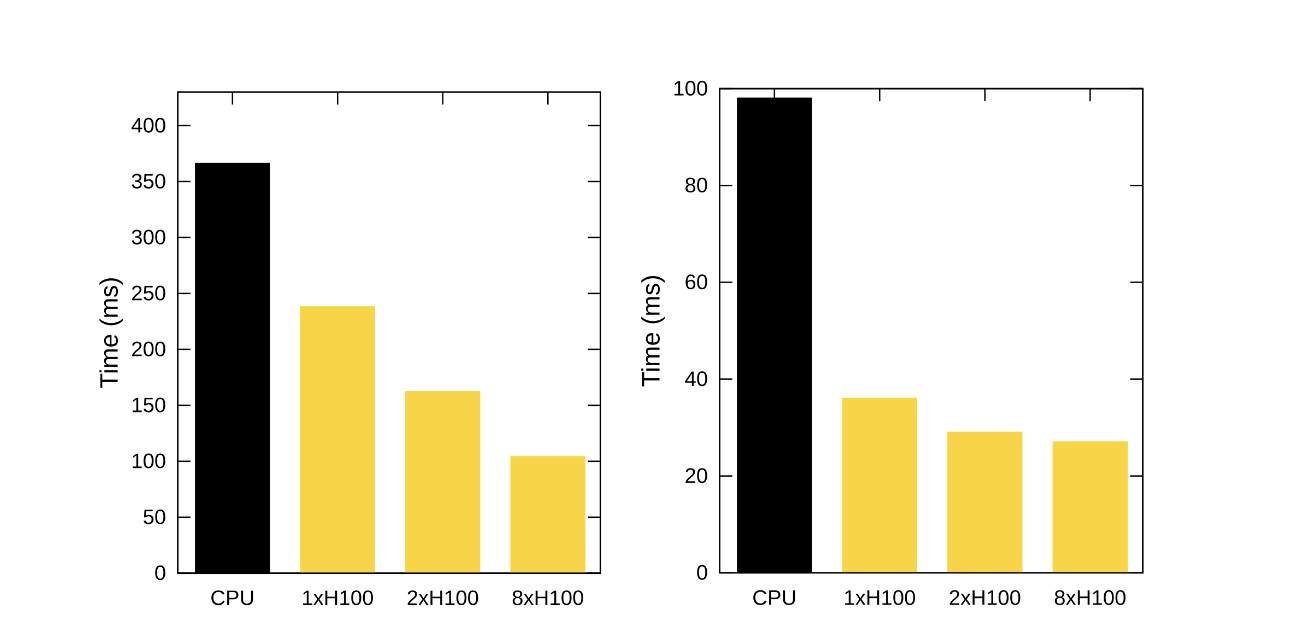
The optimal number of GPUs per operation varies depending on the operation itself and the integer precision specified by the user. Comprehensive arrays of benchmark results for both single and multiple GPUs across all specified precisions are available in the documentation.
Note that it is possible to select which GPUs to use for a computation on a multi-GPU platform, via the following environment variable:
export CUDA_SET_DEVICES=0,1,2
This will limit computation to the GPUs specified, even if the system has more available. For example, here the GPUs 0, 1 and 2 are marked as visible on the platform, meaning that even if the platform has 8 GPUs, only those selected in [.c-inline-code]CUDA_SET_DEVICES[.c-inline-code] will be used for the computation. This can be useful to perform computations on different GPUs on the same machine.
Finally, note that it is no longer necessary to manually specify GPU specific parameters to get the best performance on GPU, they are automatically configured when calling:
let config = ConfigBuilder::default().build();
TFHE-rs v0.8 introduces several other features:
With the release of TFHE-rs v0.8, the team has worked on improving the overall code stability, and added plenty of new features. Refer to the release note to see the full list. The next release of TFHE-rs will focus on introducing new data types and continuing to improve the overall performance. Stay tuned for the upcoming update!
News, research and product releases
Protocol

Solutions
PRODUCTS
Resources
community
company