Traditional banking was built for a different world. Payments designed around business hours, infrastructure that predates the internet, and a trust model built on institutional balance sheets, these weren't flaws, they were the best tools available at the time.
But the world has changed. Users increasingly expect 24/7 access, instant global transfers, and direct control over their own funds. The gap between what people expect and what legacy infrastructure can deliver has quietly widened.
Early adopters turned to decentralized finance, particularly onchain stable digital currencies — known as stablecoins — pegged to fiat currencies like the dollar or euro, hoping it would close that gap...
For the growing number of people who expect their money to run on better rails, and fit with their lives instead of the other way round, this gap is felt.
But public blockchains introduced a new problem. Financial activity onchain is fully exposed. Balances are visible, transactions can be traced, and relationships between senders and recipients can be mapped with ease.
For individuals, this is understandably uncomfortable. For businesses, it’s a non-starter. Salaries, invoices, and supplier lists are commercially sensitive, and publishing them on a transparent ledger is simply unacceptable.
A recent wave of projects has attempted to fix this by creating confidential stablecoins. Yet despite offering privacy, hiding financial activity from everyone (including regulators) makes compliance nearly impossible and prevents integration with traditional banking infrastructure.
This leaves users stuck between three problematic extremes:
At Raycash, they are building what neither traditional banks nor public blockchains can deliver: a way to hold and move money that is private, compliant, and fully under the user’s control.
Meaning that if a user's life doesn't fit neatly inside one country, one currency, or one institution, with Raycash it's supported anyway.
Their approach is grounded in three requirements that existing financial systems still fail to combine:
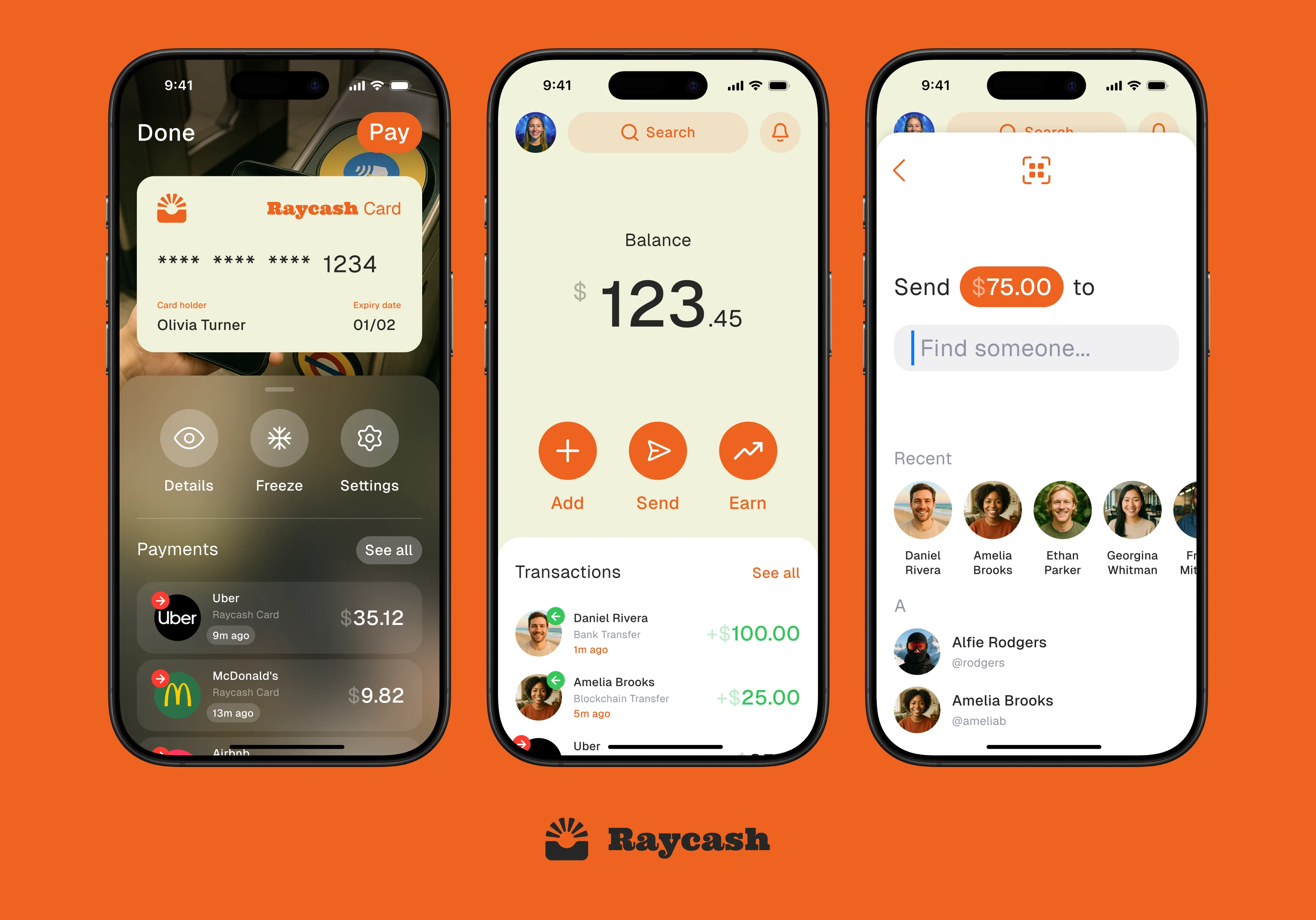
Built around these core principles, the Raycash app delivers a Revolut-style banking experience (IBANs, cards, on/off-ramps, yield) but rebuilt onchain and fully self-custodial, meaning they never have access to user funds.
Bank-grade privacy is powered by Zama’s Fully Homomorphic Encryption (FHE), keeping user activity encrypted end-to-end, post-quantum secure, while providing the regulatory visibility required for compliance.
It’s a simple concept with a powerful outcome: private digital dollars only you control, accepted everywhere.
Raycash delivers compliant privacy through a simple five-step process:
1. Deposit
Users deposit stablecoins into Raycash. Instead of issuing a new asset, Raycash supports widely adopted stablecoins (such as USDC and USDT) for maximum trust and compatibility.
At this point, the funds remain public onchain, just like any standard DeFi transaction.
2. Quarantine and screening
Each deposit enters a short quarantine window. During this period, Raycash’s screening tools check for stolen, sanctioned or high-risk funds.
Only deposits that pass screening are eligible to become confidential, ensuring privacy is granted only after compliance requirements are met.
3. Become private
Once cleared, deposits are wrapped into confidential stablecoins. This breaks the direct onchain link between a user’s public deposit, their private balance and any future withdrawals.
4. Use confidentially
After funds become confidential, users can pay, save and earn yield without exposing their financial activity, as Zama’s FHE keeps every balance and transaction amount encrypted end-to-end, even on public blockchains.
For peer-to-peer payments, sender and receiver addresses remain visible onchain to maintain the compliance-critical transparency regulators expect, while the amounts stay fully private.
5. Exit at any time
Users can convert confidential stablecoins back into standard stablecoins at a 1:1 rate whenever they choose.
Raycash represents the first time private, compliant, self-custodial finance is available in a product that doesn't require technical expertise to use.
Raycash is powered by Zama and shows, in a real product, what encrypted computation makes possible: everyday financial activity running entirely on private data.
For the Zama ecosystem and its contributors, this matters for three key reasons:
Raycash marks a turning point for the onchain banking industry. Private, compliant decentralized finance is no longer theoretical. With Raycash and Zama, it’s now real - and it just works.
The Raycash app launches in H1 2026. If you want to be among the first to try it:
News, research and product releases
Protocol

Solutions
PRODUCTS
Resources
community
company

.svg)
.svg)
.jpg)


.jpg)