Large trades don't happen onchain. They happen in dark pools, on OTC desks, and over encrypted chats because using a public blockchain to swap means disclosing your strategy to the world, being frontrun, and getting worse execution prices because of MEV. Anyone who tried to move size onchain has had to face this kind of post:
.png)
Today, we are putting an end to the tyranny of MEV by launching the first fully onchain, composable and confidential RFQ-based swap protocol, where trade size and direction are kept confidential at all times. The Zama Confidential RFQ is live in private beta on Ethereum, with a public launch planned for September, and multi-chain support soon after.
Our goal is simple: to make this the best trading venue with the deepest liquidity and best execution prices for institutional investors looking to manage a portfolio of digital assets onchain.
Ask any fund, foundation, or trading desk why they still settle large trades offchain, and you will get the same answer: privacy. On a public blockchain, everyone can see what you are trading, how much, and in which direction. Your counterparties see it. Your competitors see it. Front-running bots see it before your transaction even lands. This is the reason why crypto OTC is so huge: desks now settle an estimated $50–60 billion per day, and spot OTC volume grew 109% year-over-year while exchange volumes barely moved.
None of this should surprise anyone coming from traditional finance: in US equities (the most liquid market on earth) more than half of all volume now trades off-exchange, in dark pools and internalizers that exist for exactly one purpose: executing size without showing it. Hiding large trades is not the exception in mature markets, it’s the norm.
Think of how absurd this is: we spent a decade building programmable, verifiable trading platforms just to end up having institutional investors use Telegram groups to trade with market makers, not because the rails don't work, but because that’s the only way they can avoid being frontrun and moving the markets against themselves.
This is exactly the problem the Zama Protocol was built to solve. We already brought privacy to tokens, payments and vaults, and now we are bringing it to swaps.
The Zama Confidential RFQ is an onchain request-for-quote venue where professional market makers compete via a sealed-bid auction to fill encrypted trades. 100% of the swap fees will go towards buying back and burning $ZAMA tokens, and there are no frontend fees.
The RFQ works in four steps:
1. Submit an encrypted intent. A trader submits an encrypted swap intent to the RFQ smart contract alongside the confidential assets they want to trade. The intent hides the amount, slippage tolerance and direction of the trade. Direction is hidden by sending two confidential transactions for the deposit: one with the actual assets, and another one with the opposite leg but with a 0 amount. What you see onchain is a bidirectional transfer of a hidden amount, you don’t know if this is a buy or sell order. In the next version, we will also enable traders to send multiple assets with 0 amounts, to not only hide the size and direction, but also the asset being traded. Here is an example of what you see onchain when trading ZAMA/USDC (see it on Blockscout):
.png)
2. Market makers bid blind. Whitelisted market makers receive the intent onchain, decrypt it, and submit an encrypted quote. They only see the size, not the direction, so they have to quote both sides of the trade, which also prevents losing market makers to frontrun the winning market maker before they have settled. Quoting is onchain, meaning there is no offchain service that sees all quotes, and quoting strategy for market makers is fully preserved.
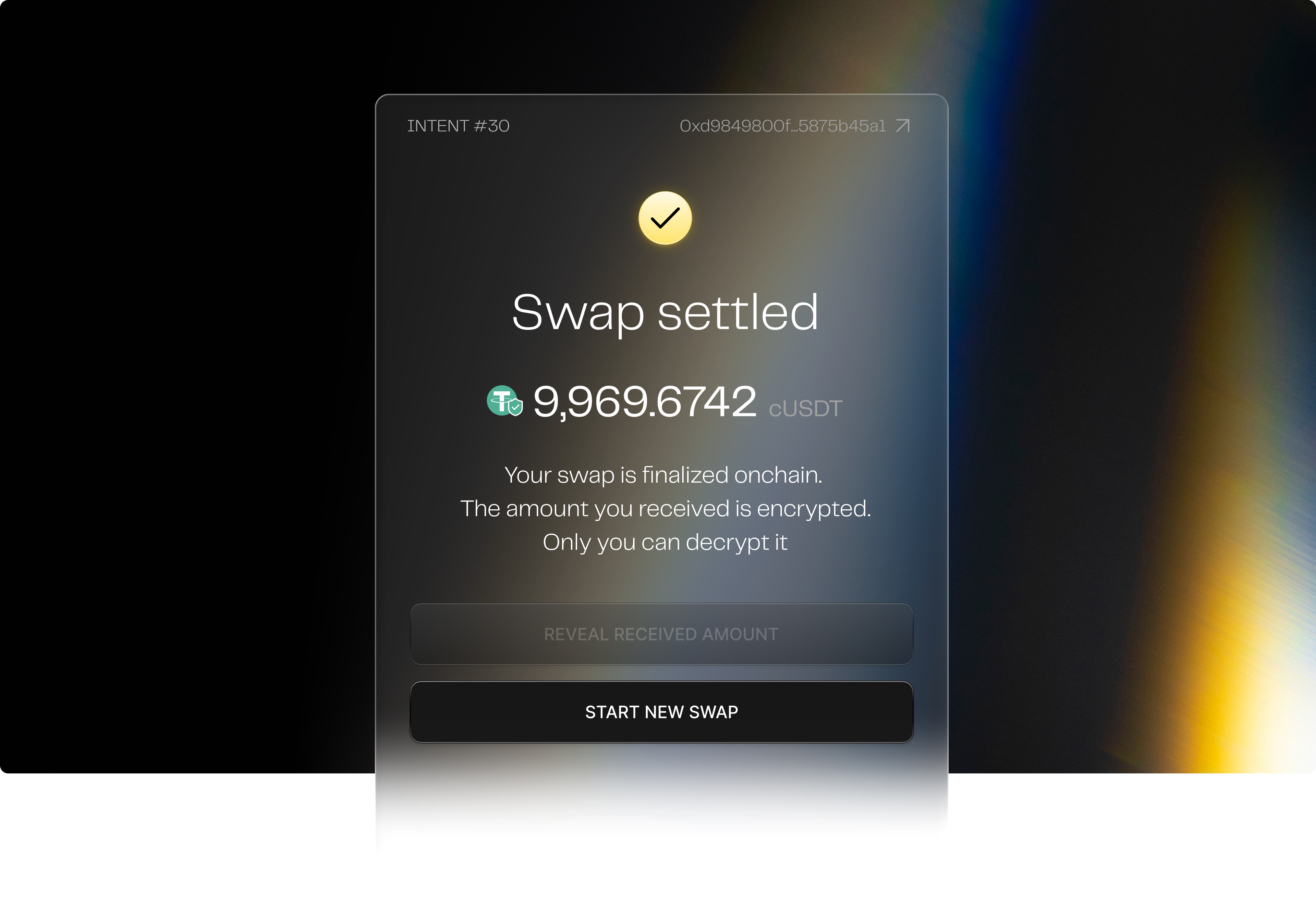
3. The contract settles the best offer. When the quoting period ends, the RFQ smart contract selects the highest encrypted quote via a sealed-bid auction onchain, and notifies the winning market maker who is then allowed to know the direction of the trade and thus settle it.
4. The winning market maker settles onchain. Finally, once the auction is resolved, the winning market maker settles by making a bi-directional transfer of confidential assets to the RFQ contract, which sends back the funds deposited by the trader initially.
The great thing about a fully onchain RFQ protocol is that it becomes composable: anyone can build on top of it, and integrate it into their own app or DeFi protocol. RFQ is now a core primitive of onchain finance just like AMMs and CLOBs before.
We designed this product for institutional investors and market makers who want to trade together onchain.
If you are a VC selling a token allocation, a foundation managing a treasury, a desk trading tokenized RWAs, a curator managing vaults or a whale who is tired of being watched, this product is for you:
If you are a market maker, you get several advantages by quoting on this venue:
The Confidential RFQ is built on ERC-7984, the confidential token standard. Anything that can be wrapped as a confidential token can trade on the venue, which creates unlimited use cases and utility for the Zama Protocol:
You get the idea: anything that can be tokenized can be made confidential and thus can trade via this confidential RFQ product.
The beta is invite-only and white-glove: request access today at app.zama.org/swap, and we will onboard the first cohort in the coming days.
The beta covers three trading pairs: cUSDT/cUSDC, cZAMA/cUSDC, and csteakUSDC/cUSDC, That last one matters more than it looks. It means you can move in and out of a yield-bearing vault position confidentially, without ever unshielding.
Public launch follows in September, with more trading pairs added based on demand including stablecoins, tokens, RWAs, tokenized stocks and more.
A year ago, confidential trading onchain was a research problem. Today the contracts are live on Ethereum mainnet, and the waitlist is open. It is no longer a question of if the biggest trades in crypto move onchain, only of when.
Ps: some features won’t be available during the beta and will be launched in September. What we are looking for is feedback from traders and market makers so we can refine the product ahead of the public launch!
News, research and product releases
Protocol

Solutions
ECOSYSTEM
Resources
community
company

.svg)
.svg)

.jpg)
.png)