While ERC-7984 is designed to be a technology-agnostic standard, this article focuses on the implementation from Zama and OpenZeppelin.
Blockchain delivered something remarkable: programmable, permissionless, global finance. But it came with a tradeoff that's held back mainstream adoption: complete transparency.
Every token transfer on Ethereum is visible to anyone. Balances, transaction amounts, counterparties, all public. For many use cases, this works fine. But for others, payroll, institutional settlement, private DeFi strategies, regulated finance, this transparency is a dealbreaker.
What if tokens could offer the best of both worlds? The programmability and auditability of blockchain, with the financial privacy people expect from traditional banking? That's what ERC-7984 delivers.
ERC-7984 is a new token standard, think of it as "confidential ERC-20". While traditional tokens store your balance as a readable number that anyone can see, ERC-7984 tokens keep it encrypted, so your balance, transfer amounts, and transaction details remain private by default.
The key innovation is that it stays encrypted at all times. Even while the blockchain is processing your transaction, adding, subtracting, checking if you have enough funds, the actual data stay encrypted. The smart contract itself doesn't know your balance. Only you can decrypt it.
This isn't hiding information from the blockchain. It's a fundamental redesign where privacy is built into the token's DNA.
While ERC-7984 is a technology agnostic standard, and can be implemented using various cryptographic techniques, Zama’s implementation is powered by Fully Homomorphic Encryption (FHE). If that sounds intimidating, here's a simple analogy:
Imagine you have a locked safe with special gloves attached. You can put items inside, close it, and then, using the gloves, rearrange, combine, or manipulate everything inside without ever opening the safe. When you're done, you unlock it and find the correct result, even though you (and everyone watching) never saw what was inside during the process.
That's FHE. It allows mathematical operations on encrypted data without decryption.
When you transfer confidential tokens, the same steps happen as with regular tokens, just on encrypted data:
All the usual logic runs. The difference? At no point does anyone, not even the smart contract, see the actual numbers.
Traditional encryption protects data when it's stored or sent. FHE protects data while it's being computed on. That's the breakthrough.
If you're familiar with the standard ERC-20 token, here's what changes:
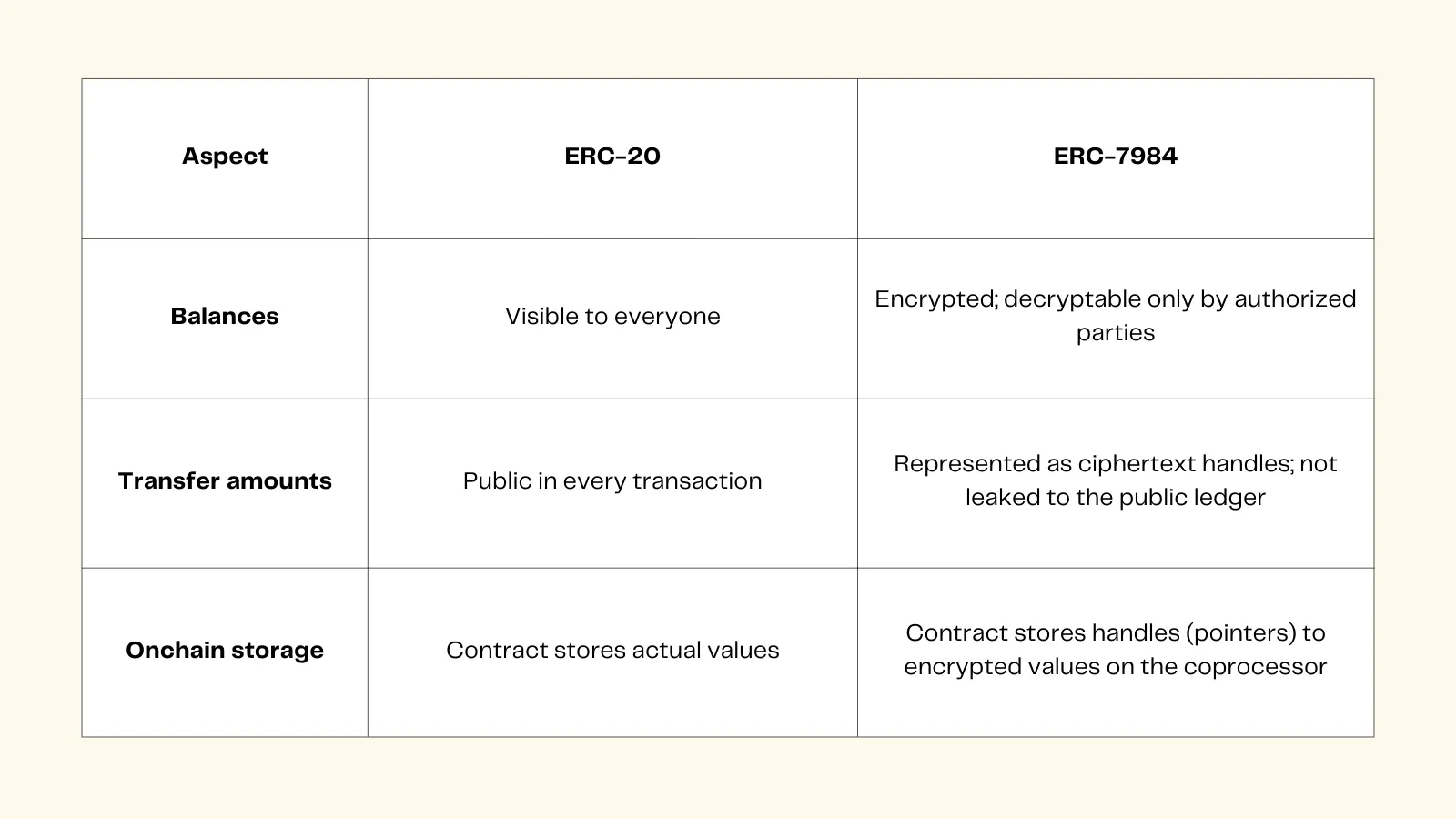
Here's a side-by-side comparison of basic operations for an ERC-20 and ERC-7984, respectively USDT (USDT) and Confidential USDT (cUSDT) tokens.
Mint.
// USD
_mint(account, amount);

// cUSDT
_mint(account, FHE.asEuint64(amount));
Transfer.
// USDT
transfer(to, amount);

// cUSDT
confidentialTransfer(to, encryptedAmount);
Check Balance.
// USDT
balanceOf(account);
// returns uint256 (visible to everyone)

// cUSDT
confidentialBalanceOf(account);
// returns euint64 (encrypted handle)
The pattern is consistent: same operations, but with encrypted data types (euint64 instead of uint256). The blockchain performs the same logic; it just never sees the actual numbers.
ERC-7984 doesn't work alone. It's a key part of the Zama Protocol, a cross-chain confidentiality layer that brings encrypted computation to existing blockchains.
On the blockchain, you have the ERC-7984 contract. It stores encrypted "handles", think of these as pointers to encrypted values rather than the values themselves.
Offchain, a network of coprocessors performs the actual encrypted math. When your transfer executes, the blockchain doesn't crunch the numbers, it sends a request to these specialized nodes that compute on encrypted data.
For decryption, there's a threshold key management system (KMS). No single party can decrypt your data; it requires multiple independent nodes to cooperate. This prevents any one actor from compromising privacy.
The Gateway orchestrates everything, coordinating coprocessors, managing access control, and handling decryption requests.
The beauty is that existing blockchains don't need to change. Ethereum, Layer 2s, and other EVM chains can support confidential tokens without any protocol upgrades.
You can also read the complete Zama Protocol Litepaper.
Confidential Stablecoins.
Banks won't put client transactions on a public ledger, it would violate every financial privacy regulation. But with ERC-7984, stablecoin transfers can be confidential while still allowing regulators to have "observer" access when legally required. Privacy by default, transparency when mandated, and compliance at all times.
Private DeFi.
Today, sophisticated traders avoid onchain DeFi because their strategies become visible. Large trades get front-run. Positions get copied. With confidential tokens, you can participate in lending, trading, and yield farming without broadcasting your playbook to competitors.
Corporate Payroll.
Companies can pay employees in crypto without exposing salary information to the entire internet. The payment is onchain, auditable when needed, but private to everyone else.
Institutional Settlement.
When banks settle large transfers, they don't want every hedge fund in the world watching their activity. Confidential tokens enable the efficiency of blockchain settlement with the privacy institutions require.
Isn’t privacy and compliance an impossible match on the blockchain? Not at all.
The Zama Protocol addresses compliance through access control and selective disclosure. Privacy is the default, but users can grant specific parties the ability to view their activity:
Think of it like banking privacy: your transactions are private by default, but your bank reports to regulators, and courts can subpoena records when justified. ERC-7984 brings this familiar model to blockchain.
Confidential tokens are still early, but the ecosystem is moving fast:
Performance: FHE operations are computationally intensive, meaning higher gas costs than standard ERC-20 transfers. Zama reports 100x performance improvements in recent years and is targeting another 100x, bringing costs down significantly.
Infrastructure: Decryption requires off-chain coordination through coprocessors and threshold key management. This infrastructure is now live on Mainnet.
Tooling: Developers are the ones who will bring this new paradigm to blockchain applications, so making their experience seamless is critical. OpenZeppelin's audited contracts and Zama's developer tools are making integration increasingly straightforward.
Coming soon: an ERC-7984 OpenZeppelin Wizard that will let developers generate confidential token contracts in just a few clicks.
Without diving into code, here's the user experience:
Sending tokens: You encrypt the amount on your device before submitting the transaction. The blockchain sees an encrypted blob, not a number. After confirmation, only the recipient can decrypt their new balance.
Receiving tokens: Your wallet holds the decryption key. When you check your balance, your wallet decrypts it locally, the blockchain never sees the plaintext.
Swapping between token types: Moving from regular ERC-20 to confidential ERC-7984 is straightforward (the amount is visible entering, then becomes encrypted). Going the other direction requires an explicit decryption step, you're choosing to make that amount public.
DeFi interactions: Smart contracts can perform operations on your encrypted balances (checking if you have enough, transferring amounts) without knowing the actual values. The math happens in encrypted form.
ERC-7984 is part of a broader movement to make privacy a default rather than an afterthought. OpenZeppelin, Zama and Inco co-founded the Confidential Token Association, working with protocols like Stellar, Fhenix, and Predicate to establish industry standards.
The vision is that confidential tokens become as normal as regular tokens, used for payments, DeFi, real-world assets, and governance, with privacy built in from the start.
We've spent a decade building transparent, permissionless financial infrastructure on Ethereum. ERC-7984 represents the next chapter: keeping those properties while adding the privacy that mainstream adoption requires.
Blockchain promised to revolutionize finance, but it came with a tradeoff: unprecedented transparency at the cost of financial privacy. ERC-7984 breaks that tradeoff.
By encrypting token balances and transfer amounts, and keeping them encrypted even during computation, ERC-7984 delivers genuine confidentiality without sacrificing the auditability and programmability that make blockchain useful.
It's not a privacy coin hiding in the shadows. It's a new foundation for tokens that respects both transparency (when chosen) and privacy (by default). For the first time, blockchain can offer the same financial privacy we expect from traditional banking, while keeping all the benefits of decentralization.
The transparent blockchain era may turn out to be a transitional phase. With ERC-7984, privacy becomes the standard.
For developers interested in building with ERC-7984:
News, research and product releases
Protocol

Solutions
PRODUCTS
Resources
community
company

.svg)
.svg)


.jpg)
.jpg)