One of the biggest challenges in launching a protocol is deciding how to distribute and price its token. Over the years, projects have tried everything—from fixed-price sales to airdrops to direct listing. After studying more than a hundred TGEs, we found that auctions offer the best balance of fair distribution, price discovery, and capital efficiency.
Today, we are excited to announce that Zama will sell 12% of the $ZAMA token supply through a series of public sales, including a sealed-bid Dutch auction, using Zama itself to keep participant bids confidential. This ensures that Zama users, developers, and operators can purchase tokens at a price they believe is fair, regardless of Zama’s previous funding rounds.
In a Dutch auction, the clearing price isn’t the highest bid—it’s the lowest price at which a bid gets filled. This makes Dutch auctions a powerful mechanism for token launches, with better distribution and more accurate price discovery. Dutch auctions have been used throughout history: by ancient Greeks to sell cattle; by eBay for second-hand electronics; by Google for its IPO; by the New York Federal Reserve for bond sales; and, of course, by the Dutch for everything from paintings to real estate to crops.
Confidentiality is a critical part of dutch auctions. When participants can see others’ bids, they can manipulate the outcome, and price discovery becomes distorted as people react to one another rather than bidding what they truly believe the item is worth. Here is a great video explaining why the “wisdom of the crowd” only works when predictions are independent and confidential. This makes Zama the perfect solution for launching tokens through auctions, but also for other use cases that require independent inputs, such as prediction markets, elections or polls.
The Zama auction will run from January 21–24, with claiming on February 2nd. Tokens purchased in the auction will be fully unlocked and immediately usable in the Zama Protocol—whether for paying encryption and decryption fees, staking as an operator, or delegating to existing operators to help secure the network.
This makes the Zama auction one of the first “post-sale”, taking place after mainnet launch, not before. Mainnet is expected to launch by the end of the year, with the $ZAMA token minted and fully functional.
You can pre-register now at auction.zama.org. It’s a good idea to get in early and share with your friends!
The Zama Protocol adds a layer of confidentiality to existing public blockchains. It uses Fully Homomorphic Encryption (FHE) to keep transaction data and onchain state encrypted while still allowing smart contracts to be executed on it.
Zama is not a new L1 or L2. It operates on top of existing chains, meaning any token or smart contract can be converted into a confidential version without bridging to a new network. If you hold stablecoins on Ethereum, for example, you can upgrade them to confidential stablecoins whose balances and transfer amounts remain encrypted, while still being on Ethereum. These confidential tokens can be confidentially transferred, swapped, or staked, just like regular tokens. Zama is essentially HTTPS for blockchain.
The $ZAMA utility token plays a central role in the protocol. It is used to pay for encryption and decryption, as well as reward operators and stakers for running and securing the network. All fees are burned, while rewards are minted following a yearly emission schedule.
You can read our litepaper to learn more about the protocol and token.
The Zama auction is a single-price, sealed-bid dutch auction running on Ethereum mainnet, using Zama itself to keep bids confidential. The auction runs in four phases:
Phase 1 — Shield stablecoins
When: Anytime after mainnet launches
Participating in the Zama auction requires confidential stablecoins on Ethereum, which you get by shielding USDT. You can shield tokens directly in the auction app or through wallets such as Bron.org.
Behind the scenes, shielding deposits your ERC-20 stablecoins into a wrapping contract and issues you the equivalent amount of ERC-7984 tokens, whose balances and transfer amounts are encrypted. While shielding is visible onchain, any transfer you make from that moment will be fully confidential. As such, we recommend shielding more tokens that you intend to bid with.
Importantly, shielding does not lock funds into the auction contract. Your confidential stablecoins remain in your Ethereum wallet and can be used just like regular stablecoins for payments and anything outside the auction.
Phase 2 — Place your bids
When: January 21st–24th
Once the auction starts, you will have four days to place your bids. Each bid includes a price and a quantity of $ZAMA tokens you want to buy. The price is public, but the quantity is private—nobody can see whether you’re bidding for 1 or 1,000 tokens at that price. You can submit as many bids as you like, at any price, and cancel them at any time during the auction.
Prices are in increments of $0.005, corresponding to a $55M FDV (based on a total supply of 11B tokens). The auction floor is therefore $55M FDV. There are no caps on price or bid size however: as long as you have sufficient confidential stablecoins, you can bid for any amount.
Unlike public dutch auctions where the price drops over time, sealed-bid auctions let you place bids at any price throughout the bidding period. This eliminates the race conditions and gas wars that typically favors larger bidders. If gas is high, you can simply wait to submit your bids later.
Because bids are private and not time-dependent, bots cannot monitor the mempool, front-run bids, or attempt last-second sniping. Humans and AI are on equal footing.
Bids can be placed through the Zama app using any EVM wallet, or through one of our partner platforms. Bids placed though one of our partners will be included in exactly the same way as bids placed on the Zama app itself. This offers more options for retail participants, which in turns improves distribution. We will announce supported platforms in the coming weeks.
Phase 3 — Clearing price and allocation
When: January 24th – February 1st
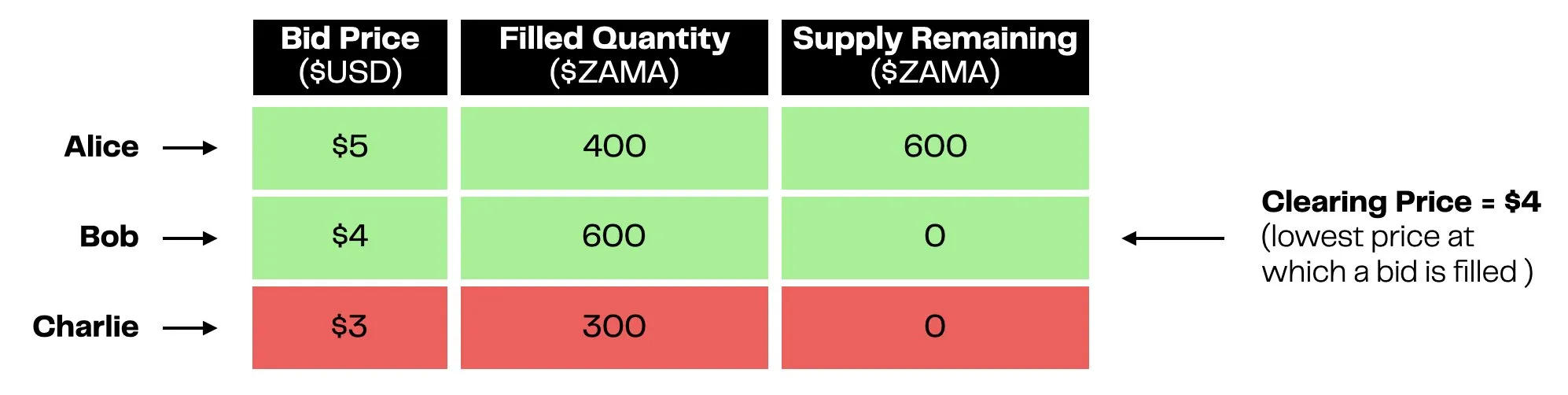
After the auction closes, bids are filled from highest price to lowest. The lowest price at which a bid is filled becomes the clearing price. All participants who successfully bid above that price will thus end up paying the same clearing price. The entire calculation is performed using FHE.
There are three possible outcomes:
This mechanism prioritizes distribution quality and price discovery rather than maximizing FDV or total sale amount. To ensure even broader distribution, we are splitting the sale in 3 parts: 2% will be sold at the floor price to our early community who won OG NFTs, with an allocation of 40,000 tokens per NFT 8% of the total supply will be sold through the main auction, uncapped 2% will be sold at the auction clearing price post-auction, with a $10k cap per participant In addition, we are offering up to 10% bonus on fills in the main auction for anyone who enters a valid bonus code, participates using the Bron wallet (bron.org) or holds an OG NFT a the end of the auction.
Phase 4 — Claim your tokens
When: February 2nd
Once allocations are finalized, participants can claim both their $ZAMA tokens and refund. $ZAMA will be distributed as standard ERC-20 tokens, and refunds can be claimed either as ERC-20 or as confidential ERC-7984.
All claimed tokens are fully unlocked and can be spent, transferred, staked or delegated to operators immediately.
Make sure to join our mailing list at auction.zama.org to be the first to know when registration and shielding opens!
Cheers,
Rand
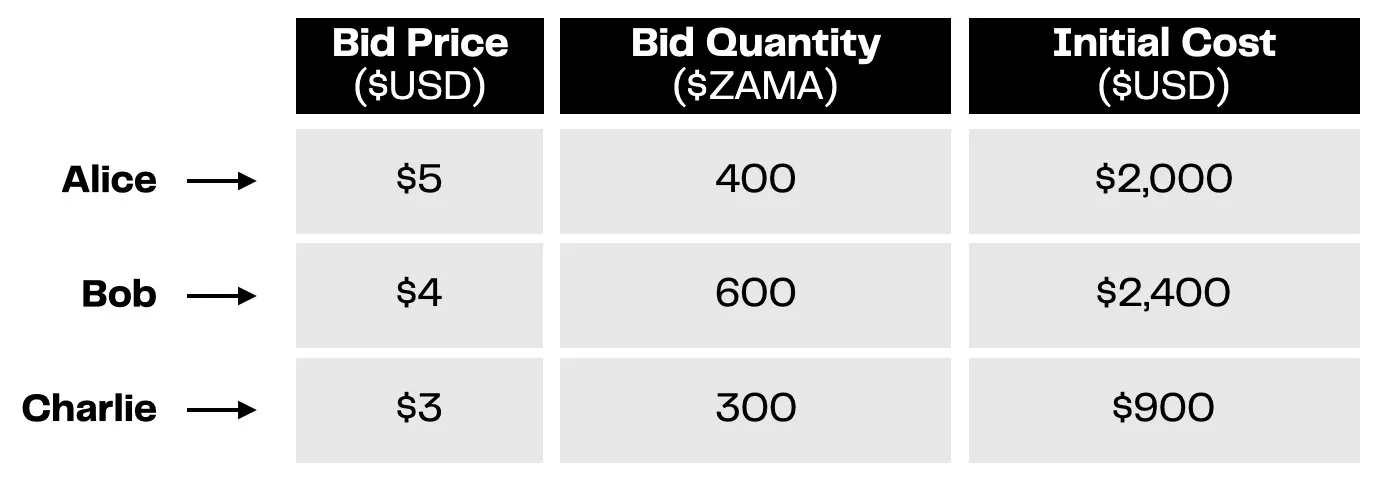
Imagine there are 1,000 $ZAMA tokens to be sold, and that you have three people bidding, Alice, Bob and Charlie.
Bidding phase
Clearing price and allocation
At the end of the bidding period, the auction smart contract goes from the highest bid price to the lowest price to allocate tokens to each participant:
Claiming tokens and refunds
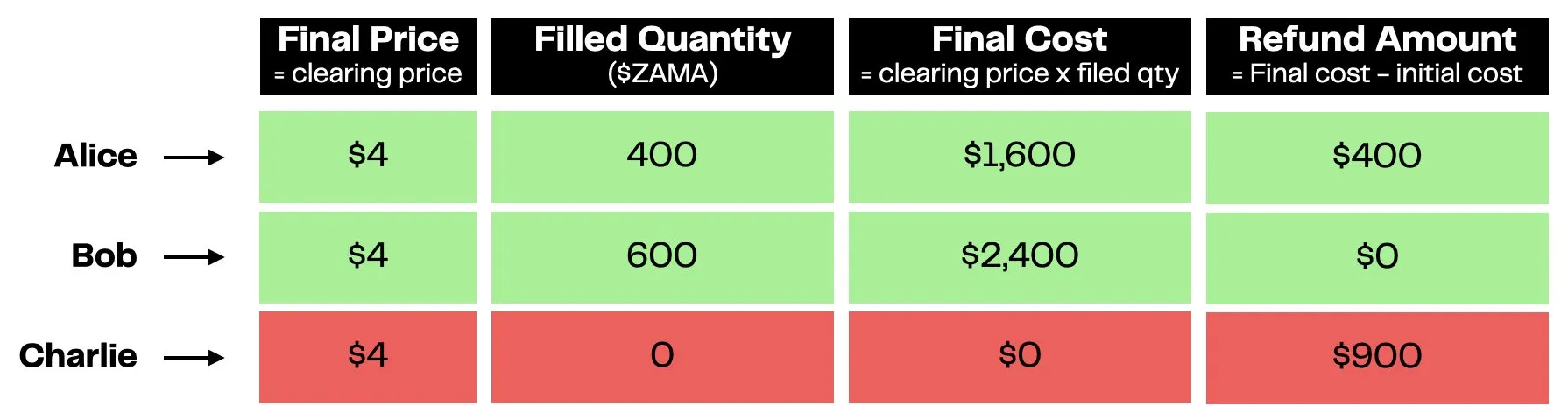
Now that the clearing price is defined, Alice, Bob and Charlie can claim their tokens and refund:
News, research and product releases
Protocol

Solutions
PRODUCTS
Resources
community
company

.svg)
.svg)


.jpg)
.jpg)